Labels

Friday, 14 May 2021

Penrith

 St. Stephen the Martyr Anglican Church

On Wednesday 12th May, Ken and I drove up High Street in Penrith to investigate the local Anglican Church in our area with a view to attending services there in the future.  Penrith lies in Darug country and the Darug people, in pre-colonial times, survived as skilled hunters, in family groups or clans and were scattered throughout much of what is now modern day Sydney.  Since moving to Penrith we have not yet found a Church we can join, due in part to the present pandemic and the rules regarding mask wearing and congregational singing.

The Church was named after St. Stephen, a Christian Deacon in Jerusalem, stoned to death in 36 AD for blasphemy and the first Christian martyr.  He is the patron saint of deacons and stonemasons.

There is a Cemetery situated behind the Church which is fenced off from the Church, but we were able to gain access via a side road.  Some of the graves were in a very poor state and quite dilapidated.  The grass was also quite high and not very well maintained.  I believe the placement of the Cemetery is quite unusual being so far away from the Church.  Most graveyards attached to Churches are quite close, but this one had a car park and Church hall in the immediate vicinity and the graveyard was a fair walk away.   

The Church is Gothic in design and built of local sun-dried brick, but as it began to crumble, it was cement rendered in 1906 both inside and out.  The foundation stone was laid in 1837 and it is the 15th oldest surviving church in New South Wales.
St. Stephen's occupies a commanding position in High Street and would have once been in the centre of the little village of Penrith.  However, the shift has now gone further down the hill  around the train station and Westfield shopping plaza. The Church's thirteen metre tower would have been a landmark for early travellers  to the area.  
Here is a statue, in the Cemetery of St. Stephen's, of an angel, looking heavenwards, on top of a monument "in loving memory" to W.D. Matthews who died in 1892.  

The last burial in the Cemetery took place in 1943.  The most important burial is that of Dr. Sir John Jamison (1776 - 1884).  He was a significant citizen in the early days of the Colony.  Jamison Road is an important road in the Penrith area and we often drive down it as it leads to the river.
There are two tall Palm trees in front of the Church facing High Street.  They are magnificent specimens and add an exotic touch to the streetscape.  I think they would have been considered exotic plantings at the time, in line with Australia being seen as a Botanical jewel in the South Pacific.
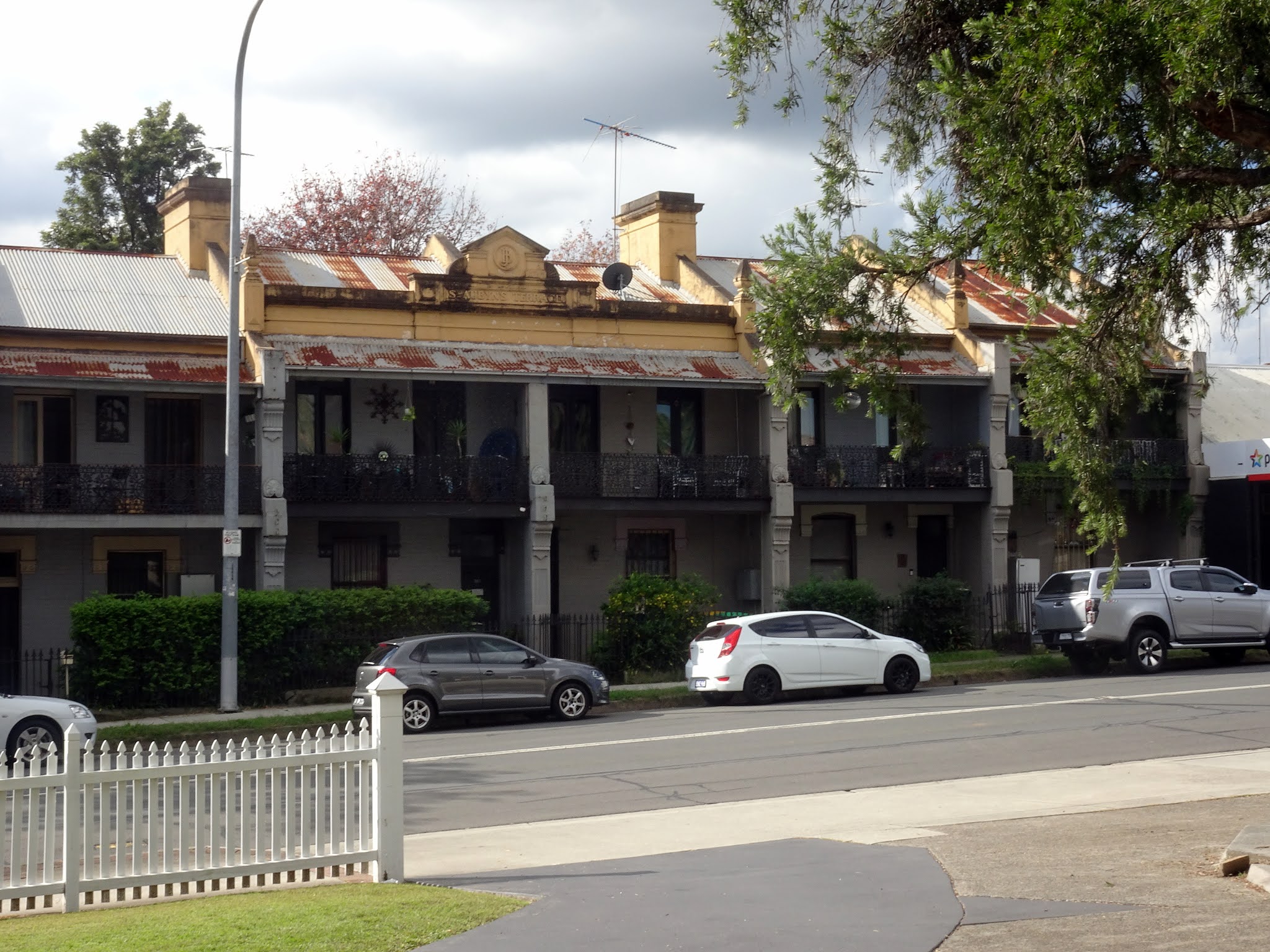
St. Aubyn's Terrace at 255-265 High Street comprising six double-storey terraces lies opposite St. Stephen's Church.  They were built and owned by English born John Brown (1809-1888) who was the father of bushranger James Buckley Brown.  John Brown also owned the historic Emu Hall on the banks of the Nepean River.  His initials "JB" are on the central parapet of St. Aubyn's, visible from the street.


I am not sure when and, if we will attend this Church in the future.  I would like to see inside, especially as I know it has a pipe organ.  The vestry door was open and Ken took a peek inside, but I was hesitant to do so and shortly afterwards a van drove up and parked outside.  It was an electrician, returning to do some work inside the Church.


Acknowledgments

Acts of the Apostles in the New Testament (Chapters 6 & 7)

Penrith City Library.

Wikipedia


Monday, 5 April 2021

Werrington

 Werrington Lake Reserve

On Good Friday, after lunch, we took a short drive to the Werrington Lake Reserve.  It is not far from our new home and we were thrilled to discover this delightful little Wetland Reserve which is a haven for the local native wetland birdlife and fauna and flora.  It is a man-made Lake developed in the 1980's as a solution to the flooding problem of the Werrington Creek.  It is a perfect spot for a family picnic with large open spaces, barbecue and toilet facilities, outdoor gym equipment and bicycle and walking tracks.  There is also a shaded children's playground with swings, climbing equipment, fireman's pole, monkey bars, spring rockers and a slide and water jets where children can cool off in the summer.

Penrith City Council has constructed the walkways, bridges, wharves, playgrounds and landscaped  around the vast complex.  It is an ideal place for students undertaking wetland and water conservation studies, but it is also a great recreational area with many picnic tables and seats dotted throughout the parklands. The Lake is used as a wetland to filter stormwater before entering the Werrington Creek  and it is also used for irrigation of the nearby cricket ground to the west and surrounding parklands.

It was a beautiful sunny afternoon and plenty of people were out and about enjoying being outdoors on the first day of the Easter holiday weekend.

We set off on the walking track around the Lake, admiring the beautiful scenery and water views, stopping every now and then to photograph the birds and wildlife.  There were plenty of seats at intervals along the track where we could take a rest.


The Lake is surrounded by tall gum trees and small native bushes, although I did notice a lot of weed infestation.  We saw ducks and other birds feeding and playing around the shores.  There are fountains of water spurting up in the Lake and a little island in the centre which adds to the visual appeal.


We saw this Eastern Water Dragon basking in the sun beside the path.  They are native to Eastern Australia.  They have long powerful limbs and claws for climbing.  They are able to swim totally submerged and rest on the bottom of shallow creeks or lakes for up to 90 minutes to avoid detection.   Their tails comprise about two-thirds of their total length.


There were lots of water birds resting on the little island.  The birds are relatively safe on the Island, free from most predators.  Human contact is not possible on the Island, save maybe from someone swimming over there!


A group of Ibis birds on rocks by the Lake's edge.  We saw many Ibis and we also saw some roosting in the trees on the little Island in the middle of the Lake.  The Ibis has adapted to changes in its' environment and they can now happily live in the city and suburban surroundings.  They have a reputation for raiding garbage bins for food.  


Now that we know about this place,  we shall certainly be making more visits in the future.  I am looking forward to coming back during the winter months and not on a public holiday when we can explore the place on our own.

Monday, 29 March 2021

Emu Plains

St. Paul's Anglican Church, Emu Plains

On Sunday afternoon we took a drive to try and find the Anglican Church at Emu Plains.  We had done an on-line search and discovered that this Church has a traditional service on Sunday mornings at 8.00 am. so we were curious to see just how far away it was from our home.   We drove over the Victoria Bridge that crosses the Nepean River along the Great Western Highway, turning right into Russell Street and then right into Pyramid Street.  The Church is situated on high ground with commanding views towards the Blue Mountains over what would have once been rural countryside.  It is bounded by Short, Mundy and Nixon Streets and also the Great Western Railway line.

The Church was closed, so we could not view the inside, but I believe there are some stained-glass windows.  I am not sure whether the Church is used, because there seemed to be a large Ministry Centre with a hall on the opposite side of the road, where the doors were open, as if ready to welcome a church service later on that afternoon.

Alongside the Church is a cemetery  The Cemetery retains a formal layout in its original section located to the east of the church with gravestones laid out on either side of a broad grassed path and is lined with poplars, white cedars and pines. The grave memorial of the Ryan family is prominent in the collection of older grave stones. More recent burials are located on the open sides of the hill. The church site also includes a pair of weatherboard c.1950s classroom blocks, and a c.1990s brick hall. The buildings are set within stands of jacaranda trees and other mature landscape plantings concentrated along the southern boundary including radiata pine, poplar, white cedar, pepper, and brush box.  Many of the gravestones are in a dilapidated condition.  

In 1929 a bushfire burnt down the rectory destroying many of the Parish records.  The inscriptions on the gravestones now provide the only historical evidence of the occupants of the gravesites.  In 1967 the cemetery came under the administration of the Penrith City Council.


St. Paul's is an example of Victorian Gothic-Revival, constructed of stone and completed in 1848 to a design by Edmund Blackett.  It contains a nave, chancel, vestry and porches.  It is quite a pretty looking church, but I suspect the inside may not be in such good condition.
The gabled roof has a bell turret on the west gable containing a brass bell.  The roof is mainly slate tiles, with some corrugated galvanised steel being a more recent addition.
Part of the Anglican section of the Cemetery.  There was evidence that some large trees had either been cut down or fallen down in storms, as there were several stumps lying around.  The roots of these trees has caused obvious damage to the gravesites.
Some of the gravestones dated from 1860.  You can see the backdrop of the Blue Mountains as you look westwards.  The Cemetery is kept in good order and condition by the Council and the grass was neat and tidy on the avenues between the gravestones.

We enjoyed our little exploration of the Cemetery and would have liked to see inside the Church.  We are not sure whether it is a Church for us, but  shall continue to investigate a few more possibilities in our neighbourhood over the coming weeks.

Emu Plains is the traditional land of the Darug people.  The first British explorers, led by Watkin Tench, surveyed the area in 1790 and named it Emu Island after sighting some emus on land they mistakenly thought was an island in the River.  Governor Lachlan Macquarie renamed it Emu Plains when it was realised that occasional flooding of the River gave the Plains the appearance of an island.

Acknowledgments

1.  N.S.W. Office of Environment & heritage
2.  Wikipedia
3.  Emu Plains Anglican Church.org.au


Sunday, 11 October 2020

Winmalee

Tracey's Garden

Yesterday we enjoyed a visit to a garden in Winmalee belonging to Tracey.  She and Mary, another  passionate gardener and collector of plants, were banding together in a sale of a wide range of hand planted #succulents and cacti potted up and ready to take home,  or as a gift for someone special.  They had advertised their sale on our local Community Facebook page, with the invitation to direct message Tracey to get the address to her house, 48 hours before the sale began.

Tracey and Mary are neighbours and live in my neighbourhood in the Blue Mountains of NSW and I have followed them both on instagram for the last two or three years.  I was delighted to discover that Tracey's house was not far from our house in Winmalee,  in fact we could have walked there!  However, as we were expecting to buy plants, we chose to drive so we could transport our purchases back home easily.  I was looking forward to actually meeting them both in person.  

We parked our car in the street outside Tracey's house.  As we live in the Mountains, properties are generally either on the upside of the street or on the downside leading into a valley and Tracey's house was below the level of the street and accessed by a steep driveway.  It was with some difficulty I negotiated the steep walk down the driveway, but with Ken's help I made it safely!

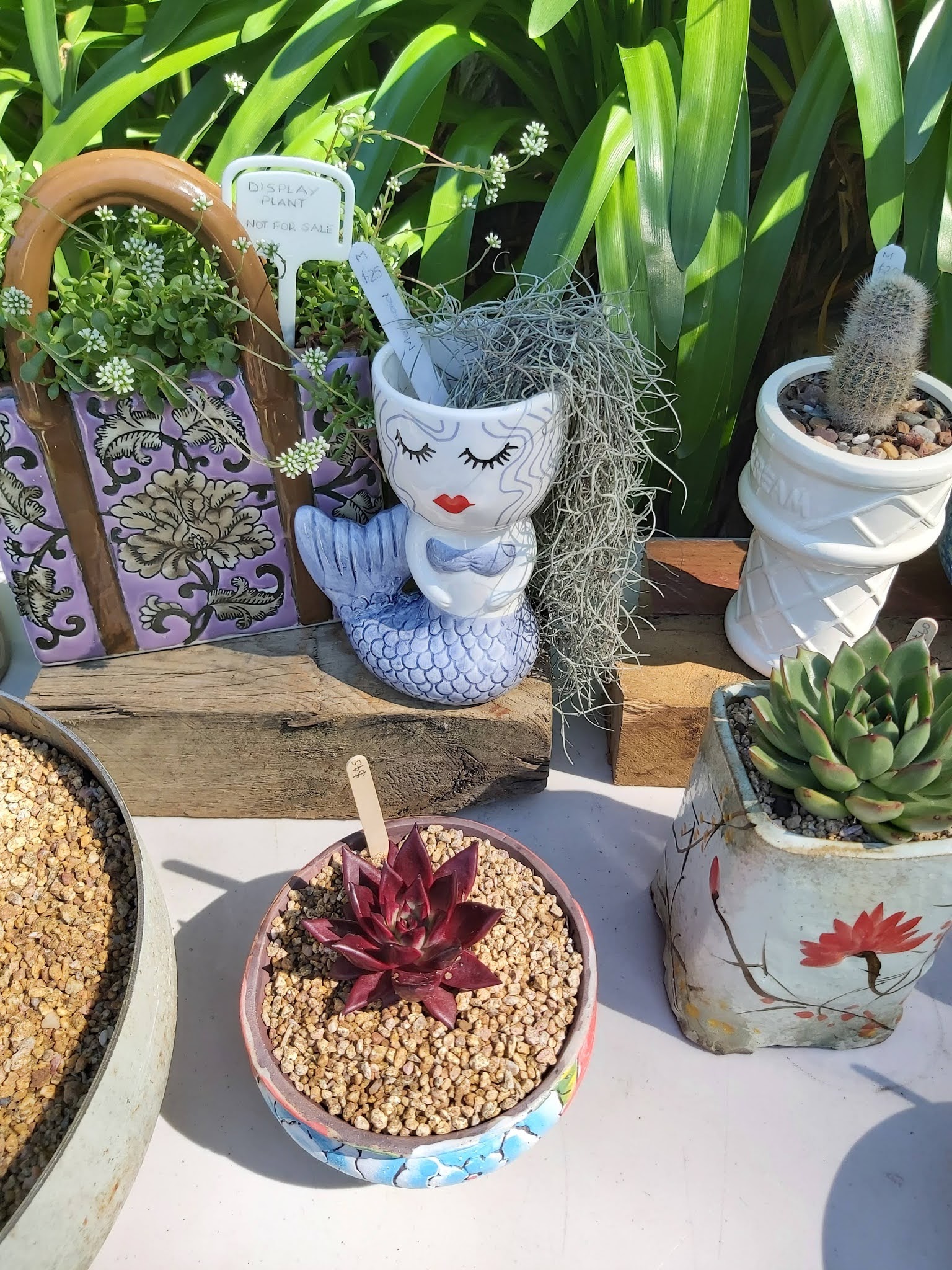
Some of the plants for sale

Tracey was pouring herself a cup of coffee and recognised me straight away.   I felt as though I already knew her. I knew she had a passion for succulents, cute garden pots, coffee and cake and loved the natural wildlife in our area, so, of course, we shared a lot in common.   

Her love of cute pots is evident with many of her succulents displayed in some unusual pots.  I believe she also runs workshops in how to care and look after succulents, so she must have a lot of expertise and knowledge in how to grow beautiful succulents.  

I love the little mermaid pot (left) with her Tillandsia hair trailing out the top!

I have plenty of Tillandsia (also known as air plants) in my garden.  I need to look around for some interesting pots to display it in, preferably a head so it looks like hair!
We did not get to meet Mary as Tracey said she was not feeling well and was resting at home.  I think she had been able to help Tracey yesterday with setting up the plant display and bringing some of her own plants for the sale.

Another cute head planter (right) with a jelly bean succulent growing in it. 
I loved this little section of her garden, to the side of the driveway.  In front of the raised stonewall garden, there was a wheelbarrow full of Aloe vera plants coming into flower and ready for potting.

Tracey also had trays of cuttings of various succulents priced at just $1.00 each and I picked up one of these for potting up when I got home.
Here on the right are the plants I bought at the sale.  I love the blue pot in front with the flowers painted on it, but not sure of the succulent growing in it.  It is an Echeveria, but do not know the variety.  There is a little flower forming on it.

At the back is a Peperomia dolabriformis (Prayer Pepper) with leaves appearing like little fat pea pods.

On the left is String of Pearls, a succulent I have always wanted (Senicio rowleyanus). It likes to sprawl over the edge of containers or hanging baskets. I also bought a couple of other small pots with unknown succulents in them to add to my collection.

We enjoyed our time spent looking at the plants on display, but I would have liked to have seen a little bit more of Tracey's interesting garden which is spread out on over half an acre.  I know, from her instagram posts, that her husband has built some lovely pathways and steps and retaining stonewall gardens.  However, it was not an open garden display and I am sure that now we have met, there will be other opportunities when we can visit each others' gardens!


Tuesday, 6 October 2020

Winmalee

 Cuckoos

They've arrived in Winmalee!  I have heard the first Cuckoo of the season, coinciding with the clocks going forward for daylight saving.

These migratory birds capture my imagination as they seem to herald Summer and the long hot days that lie ahead.  As I went to bed on Sunday night I heard the strident wailing love-call of a Cuckoo piercing the stillness of the night sky as he claimed his territory and sought to summon a mate.

They migrate all the way from Indonesia and Papua New Guinea and, after mating, the female lays her eggs in the nest of a surrogate bird, generally a Currawong or Magpie.  The large chicks monopolise the poor foster parents, demanding all the available food and edging the other chicks out of the nest.

Channel-billed Cuckoo - Scythrops novaehollandiae.

I have not seen very many Cuckoos   I only ever seem to hear them!  They are as much the sound of the Australian bush as the Magpies and Whip birds.

This picture (right) is taken from The Australian Museum website.  See link  here

 
They like to eat native fruits and figs and sometimes insects.

This photo (left) is of a Channel-billed Cuckoo in a fig tree in Toowong, Queensland taken by Mick McKean.
Photo (right) of a Channel-billed Cuckoo taken by Keith Hutton.

They are noisy birds, but quite shy, often heard but not seen.  They like to sit in the top of tall trees.

We have many tall trees in our backyard, so I shall be trying to catch one this Summer with the zoom on my camera!


This is a photo I took of a Cuckoo in a tree in our backyard in Winmalee in October, 2018.  I do not think it is a Channel-billed Cuckoo.   I posted the picture on instagram and one of my instagram friends identified it as a Koel, which is another name for a Cuckoo.  This could be a female Pacific Koel also known as the Eastern Koel.

They do not like the cold weather, which is why they migrate back North for the Winter.  The migration route is across the Torres Strait and from New Guinea they migrate across the nearby islands, as far as Timor and the Moluccas.  They travel individually, or in small groups.

They delegate the raising of their chicks to other birds, to do the work for them!  However, the female does hover around, ready to help feed her growing baby bird.

There are also Cuckoos in the Northern Hemisphere and they migrate to Africa during the European Summer.  There is a beautiful poem by William Wordsworth called To the Cuckoo which can be found  here 


Acknowledgments:

1.  The Australian Museum
2.  Backyard Buddies
3.  Wikipedia
4.  Read & Co. Books


Sunday, 20 September 2020

Mount Wilson

St. George Church

In the pretty township of Mount Wilson high in the Blue Mountains of New South Wales, there is a delightful little church called St. George built as a memorial to an important and progressive resident of that small Mountain community, who died in the early years of the twentieth century.  

His name was Henry Marcus Clark who rose to fame as a prominent Sydney retailer establishing a retail store chain in 1883 with a network of branches in towns and suburbs across Australia.  He began in the Sydney suburb of Newtown, but later expanded into George Street in the heart of Sydney opposite the new Central Railway Station.  The store was called Marcus Clark & Co.  a Department store in an impressive 9 storey high building, the tallest skyscraper in Sydney at the time.    The building, is now known as the Marcus Clark building, and is home to the Sydney Institute of TAFE.

I have a family connection to Henry Marcus Clark as he married my Great Aunt, Martha Anne Day (known as "Pattie") and after her death he married her sister Georgina May Day (known as "May").  Between the two sisters there was a family of seven children, my father's cousins.

As a child, my sister and I spent school holidays at Sefton Hall in Mount Wilson with our extended Day family relatives.  This was the home, bought from the Cox family and transformed by Henry Marcus Clark into the imposing and grandly titled Sefton Hall, where he lived for the last three years of his life.  The home was retained as a holiday home by the Clark family for many years after Henry passed away.  My sister and I have happy childhood memories of our time spent there and especially exploring the house and grounds of that grand old house, with our cousins and even attending Sunday School in the Caretaker's Cottage. 

The Church and cemetery sit in a picturesque setting of Australian tree ferns and Eucalypts, but it still evokes the feeling of an English parochial village church.  The Church was built on land donated by Richard Owen Wynne, the owner of Wynstay and the cost of the building was borne by the Clark family.
This is Sefton Hall where Henry Marcus Clark lived.   He became very ill with pancreatitis and in 1913 specialist physicians were called in and they quickly decided to perform an emergency operation on the dining room table!  Unfortunately, it was not successful and he did not survive the operation.
The Church is built of fibro and timber battens were used to cover joins in the fibro walls.  There are pressed metal surrounds at the base of the building, which were popular at the time as a cheaper alternative to sandstone.  The same building materials are used in Sefton Hall.  The Church was built by Albert Kirk from the prominent Kirk family living in the area.
This is a stained glass window in the church erected in loving memory of Henry Marcus Clark.

Henry Marcus Clark was born in Lancashire, England in 1859 and grew up in the village of Sefton near Liverpool.  He migrated to Australia at the age of 21.  He lived briefly with his uncle in Melbourne, but travelled overland to NSW and took up employment in John Kingsbury's drapery store in NewtownJohn Kingsbury was the son of one of the founding fathers of the Churches of Christ in NSW and Henry Marcus Clark had a similar religious conviction.  

Henry met Martha Anne Day whilst working in the Newtown store, as the Day family lived close by in Marrickville.  The Day family were also of the same faith. William Edwin Day (my grandfather and Martha and May's brother) was a lay preacher and their father George Day (my great grandfather)  was a Minister of Religion in the Church of Christ.

Henry Marcus Clark was succeeded by his eldest son Reginald Marcus Clark.  However, Reginald's views and ideas were changing, as the First World War was about to begin and the Church of Christ connection did not survive for long after the death of Henry.   The beautiful Church of St. George, built in Mount Wilson as a memorial to Henry Marcus Clark in 1915, was consecrated as an Anglican Church in 1916.  

The Church today is part of the Anglican Blackheath Parish and services are normally held on the second Sunday of the month at 3.00 pm.  Visitors are usually welcome, but during these Covid times there may be restrictions in place.


Acknowledgments
1.  NSW Government Office of Environment & Heritage Mw004
2.  Community Website of Mount Wilson and Mount Irvine
3.  Paper No. 2 Churches of Christ New South Wales Occasional papers
in history and theology.
4.  Blue Mountains Library local studies.


Thursday, 10 September 2020

Winmalee

A walk around my Spring garden

We have not been for any walks lately, so I thought I would take you on a walk around our Spring garden at our home in Winmalee.  We live in the Blue Mountains of New South Wales at an altitude of 370 metres and are 80 kilometres west of SydneyWinmalee is an Aboriginal word with the debatable meaning "in a northerly direction" and was officially named in 1972,  being previously known as North Springwood.  Residents at the time objected to the new name, but now it is loved and accepted by everyone.  It is in Dharug native country.

Here is the May bush blooming in a corner at the front of our house.  It has flowered well this year, thanks to our neighbour Ben, giving it a good prune with his electric saw a few months ago.  I like to keep it this height as, if it gets too tall, it blocks the view from the window.
Here is a close-up of the May flowers, with droplets of water on them after an early morning shower of rain.
Spiraea cantoniensis double white May bush, native to China and in the family Rosaceae.
The side Photinia hedge, now in full bloom and with red tips starting to shoot up the top.  This also has to be kept in check and pruned regularly.  Mike came and did it last April.
Photinia Red Robin has fiery red foliage and cream coloured flowers, very attractive to the bees!
Here is one side of the house with a little gate, looking down to the rainwater tank, which I use to water some of the garden.  Paul came recently and pruned back the Azalea bush underneath the bathroom window and also chopped down the Oleander bush outside the third bedroom window as it was getting too big and straggly.
The Diosma bushes in full bloom at the back of the house.  They are getting pruned by Terry tomorrow as they are getting too big and blocking my view of the back garden from my desk under the window.  He is also going to clear this garden.
Coleonema - pink diosma is native to South Africa.
The Leptospermum  "Cardwell" and white Azalea flowering on the left side fence.  
I planted the Leptospermum in March last year.  It is a rounded shrub with slender, slightly weeping branches, densely clothed in small narrow, grey-green scented leaves that smother the plant in Spring creating an outstanding display.

The Azaleas are all blooming magnificently.  The lawn was mowed by Mike two days ago and he is coming next week to poison the weeds that you can see in the foreground.  They got out of control during our wet winter and have popped up everywhere.
Another view of the Azaleas and behind them the Robyn Gordon Grevilleas which have been flowering all winter and frequented regularly by the Honeyeater birds.  I have seen Wattlebirds, Eastern Spinebills, Rainbow Lorikeets and Noisy Miners in there.  The bare branched tree is a Liquidambar, starting to sprout its new leaves.
 A close-up of one of our flowering Azalea bushes.  Unfortunately I did not keep a record of the names of the varieties of Azaleas we planted, so have no idea what they are.    I know we have Rose King out the front and that is ready to burst into flower very soon.  We also had Rose King at Auburn and it is one of my favourites.
Looking down the backyard.  There is a birdbath between two Magnolia bushes.  We have many birds that visit our birdbath and I love to photograph them, zooming in on them, with my camera, from the back deck.  There are white Azalea bushes in a garden around the Tibouchina tree.


Well I hope you have enjoyed our little walk around some of our garden.  We also have another Photinia hedge facing the street, but this and surrounding gardens, are in the process of being rejuvenated by Ky, so I have not shown a photo of this.  He is doing a good job, but at the moment he is busy with school work as he is preparing to sit for his final HSC exams so he's rather busy!

There is also a lot more to see down the back, but I will leave that for another occasion!