Labels

Sunday, 20 March 2022

Emu Plains

 Emu Hall, Emu Plains

After the deluge of rain in recent weeks, the sun finally made an appearance last Thursday.  It was too good an opportunity to miss, so we decided to go and check out our local Nepean River to see if its level had subsided.   There has been widespread flooding of areas around Penrith caused by the Warragamba Dam overflowing into the swollen Nepean and Hawkesbury Rivers,  flooding the low lying land along the river banks.  

We drove in our car to Memorial Avenue and parked near the beginning of the walk to the Yandhai Crossing which is the footbridge over the river.  There is a lot of building work going on around this area due to the new Log Cabin Hotel being rebuilt on the banks of the River.  We safely negotiated the construction site and reached the entrance to the bridge where we noted that the level of the river was pretty much back to normal.  There was evidence of damage to the banks of the river with a lot of vegetation debris hanging around and piles of dirt and mud.  The river itself looked very muddy.

It was a nice, sunny afternoon and very hot as we walked over the bridge.  We noticed that Emu Hall, which is now a Restaurant on the Emu Plains side of the bridge, seemed to have new car parks surrounding it, so we decided to investigate further.   When we reached the other side of the river we left the bridge and walked down a path that led to the grand entrance gates to Emu Hall.  We walked through the entrance and and took a stroll around the gardens and grounds of the building.  Emu Hall is now much more accessible with plenty of parking for visitors.  There is also a cafe, bar, beer garden as well as the Restaurant.

We decided to pop in for a cool drink and were shown to a table on the verandah.  It was lovely sitting there in the shade, enjoying our drink.

Billionaire, Arthur Laundy is spending $35 millon redeveloping the Log Cabin Hotel.  The old Log Cabin Hotel was destroyed by fire several years' ago.  

There will be indoor and outdoor bars and dining areas overlooking the Nepean River.  It will be a feature of the Great River Walk.
The Yandhai Crossing, a footbridge over the Nepean River.  This is a popular bridge and there are many alcoves and lookouts along the way to gaze out over the river.

I love the modern architecture of the bridge and how it is a complete contrast to the old Victoria Bridge alongside it.
The Nepean River is very muddy after the recent flooding of the river.  We could see lots of damage to the river banks and uprooted trees and loose branches strewn in the water.  However, the water level now seems back to normal.
Historic Emu Hall, gaily festooned with fairy lights for night dining.  

This historic homestead has been refurbished into a modern 21st century setting while maintaining its remarkable features, including cast-iron lacework and large French windows and doors that open onto a beautiful garden.

We sat out on this side verandah sipping our cool  Iced Chocolates.  The verandah was the ideal shady place to sit on a hot afternoon.  It was very pleasant.

We looked in at some of the beautiful original indoor rooms which are now dining areas, furnished with modern decor. 
Here is the Victoria Bridge built in 1862-1867 which carries two lanes of the Great Western Highway and alongside it is a later bridge built in 1907 to carry the western railway line up and over the Blue Mountains.  

The M4 Motorway bridge further down the River is now the main arterial road up the Mountains.

Acknowledgments

1.  realcommercial.com.au article by Lisa Allen (information about Log Cabin Hotel).

2.  emuhall.com.au (information about Emu Hall)

3.  Wikipedia (information about Victoria Bridge).


Tuesday, 1 March 2022

Glenbrook

 Art Exhibition in the Community Hall

On Sunday we drove up to Glenbrook in the lower Blue Mountains to visit The Nepean Art Society's Summer Exhibition in the local Community Hall.  This Exhibition is popular with the local community and also collectors, as there are many gift items as well as paintings for sale.  The Nepean Art Society was formed in 1967 by a small group of local artists and continues to be a vibrant Society today with over 150 members.

Glenbrook is located 63 kilometres west of Sydney at an elevation of 163 metres and has a population of over 5,000 people. Glenbrook is over the Nepean River and at the top of Lapstone Hill.  It is a lovely little township, conveniently located just off the Great Western Highway, with many trendy cafes and boutiques along its main street.  There is also an entrance road, through the township, into the Blue Mountains National Park.


Along the Highway, before entering the town, there is a great Visitor Information Centre. ðŸ Š 
It also stocks maps, books and a good range of gift ideas.  The staff are very helpful and they were able to give me information regarding the closure of the road in the Blue Mountains National Park due to floooding of the causeway during recent rain.  We are hoping to explore this region soon.
🠈 The Community Hall, where the art exhibition took place, is behind this stone wall.  The Glenbrook Cinema is also here, alongside the Community Hall.  

The wall announces that Glenbrook is the gateway to the Blue Mountains.
This oil painting is titled "Silverton". 🠊

Silverton is a small town in the far west of New South Wales and 26 kilometres north-west of Broken Hill.  

Silverton has attracted artists, photographers and cinematographers for many years due to its stunning landscape and superb light.  

Silverton thrived back in the late 1800's during the Gold rush days.
🠈"On the Murray (Barham NSW)".  Barham is a small town on the banks of the Murray River.  It  is a pretty town surrounded by rich river flats.

From the early 1870's timber cutters began to set up camps and log the River Red Gums that grow in the surrounding forests.  Koondrook, on the Victorian side, developed more quickly than Barham and soon became the centre of a large forest industry with the timber being used to build boats and paddle steamers.
 
One of my favourite birds is the Pelican and I think this is a lovely painting of a Pelican.🠊

I have seen Pelicans in the Nepean and Hawkesbury regions.  They are large water birds characterized by a long beak and a large throat pouch used for catching prey and draining water from the scooped-up contents before swallowing.  Their plumage is mostly white.


🠈"A view from Streeton Lookout" at Freeman's Reach, New South Wales overlooking the Hawkesbury River with views from the edge of the escarpmnt over the Richmond Lowlands and looking towards the Blue Mountains.

This is a popular spot where local artists gather to paint or sketch the landscape from this historic location.

The lookout is named after Sir Arthur Streeton (1867 - 1943).  Sir Arthur visited the Hawkesbury in 1896 and it was here that he painted some of Australia's most famous paintings.

We have an oil painting called Hawkesbury River which we purchased in recent years and it looks very much like this painting.  I wouldn't be surprised if it was painted from this same lookout. 

These are just a small selection of the many outstanding paintings at the Exhibition that took my fancy.  Despite the rain over the 3 days of the Exhibition I believe it was their most successful Exhibition ever with sales of  oils, water colours, pastels, acryllics, pen and ink, paper toille, sculptures and gift cards.

Acknowledgments

1.  Silverton destination brokenhill.com.au
2.  Wikipedia (information about Barham)
3.  Australian Bird Life (information about Pelicans)
4.  Hawkesbury People and Places (information about Streeton Lookout)
5.  Nepean Art Society Facebook page.


Wednesday, 23 February 2022

Cranebrook

 Mountain View Reserve

Last Sunday we visited a bushland reserve nestled on the outskirts of Cranebrook, just 5 minutes drive from our house.  It is on the traditional lands of the Darug people and is an easy 1.8 kilometre track with another steeper track leading up a hill to a lookout and viewing platform over the Penrith lakes and the Blue Mountains.

I was very keen to visit this bushland area and let that desire get in the way of common sense!  We chose an extremely hot day and, as most of the path is on a treeless plain with no shade cover, it didn't take long for us to start feeling the heat!  To make matters worse, it is a paved path which retains the heat from the sun that was beating down upon it.  The heat was bouncing back on to our bodies and in no time at all our faces began to look like bright red tomatoes!   

We had spotted this Reserve on our earlier Lakes Walk and I was keen to explore it.  However, I had tried to curb my excitement and refrained from suggesting to Ken that we do it in the hot Summer weather, mainly because there appeared to be no shade.  However, as rain was forecast in the coming days, curiosity got the better of me and, we decided to attempt the walk in the blazing heat of a hot Summer's day, before the Autumn rains set in.

Here is the start of  the Mountain View Reserve   containing bushland only found on the clay soils of the Cumberland Plain in Western Sydney.  It is set out on approximately 13 hectares of bushland and 8 hectares of wetland.  There are not many trees on the lower portions but higher up on the hill there are Grey Box Eucalypts and Forest Red Gums.
As we set off on the path, we saw the dirt bush track and steps leading up the hill to the lookout and viewing platform but decided to leave this for a cooler day.   It appeared to get very steep, but I'm sure the view over the Lakes and the Blue Mountains would be totally worth it!
There were many drawings etched into the pathway,  representing the local wildlife and plants of the area.  Also along the pathway were some stone benches and pillars with metal sculptures adorning the tops of the pillars.  Here is one with a Kingfisher holding a fish in its beak.
We came to a track leading to a  bird hide and  walked down this track, into the hide.  There were viewing windows in one side, with ledges to rest a camera or binnoculars to view the native birdlife.  The hide is close to Melaleucas, where finches and Cisticolas may be seen.  We didn't see any birds, so made our way back to the paved walkway.
We saw many wildflowers,  especially this purple flower, which was in abundance.  I used my Plant Identifier app and it described it as Purpletop vervain or Clustertop vervain.  It is a Verbena plant native to South America and the lavender flowers are perfumed.
There were also many native grasses including Kangaroo grass (Themeda australis).
I spotted this insect on a tree trunk and I think I have correctly identified it as the Botany Bay Diamond Weevil sometimes called the Diamond Beetle (Chrysolopus spectabilis).  It was discovered during James Cook's first voyage to Australia by the Naturalist Joseph Banks in 1770 and was one of the first insects to be described as native to Australia.  It is black with irregular blue spots and has a long snout.  It feeds on wattle trees.  

We kept a lookout for the endangered Spiked Rice-flower (Pimelea spicata) which we had read is found in the bushland in this Reserve.  It is very rare and is a protected plant under State and Federal law. 

We soon came to a track leading to the freshwater wetland which is an endangered ecological community and subject to periodic flooding.  It is located on low-lying parts of the floodplain.  Most of the time it lacks water and is dominated by dense grassland surrounding it.  The soil, rocks and plants act as natural filters for stormwater pollutants before the water flows on to the Penrith Lakes.  We thought we would feel a bit cooler in this area, but it was intensely hot and we felt suffocated by the grass and sedges arching above our heads as we walked along the path.  We could hear the buzzing of cicadas ringing in the air as we crossed a little bridge over a dry creek bed.  We could imagine, in wet times there would be water beneath the bridge and the sound of frogs croaking.

We continued along the path until we reached the end of the Reserve with an exit into Soling Crescent.  Here we noticed a sign warning people to beware of snakes in the Reserve.  

Across the road we noticed a fenced in wooded area with tables and chairs under shady trees.  We made our way to this area and saw a sign declaring it was a leash-off area for dogs.  We opened the gate to go  inside and sat down in a cool spot to have a drink of cold water which we had brought with us in our backpack.  We didn't see anyone exercising their dogs, probably much too hot!

After a short rest we walked back through the Reserve and returned to our car.  By this time we were exhausted and feeling very hot and sticky and glad of the cool air-conditioning in our car as we drove away.   We decided to come back again when the weather gets cooler as there is still much to explore and we wanted to look for the Spiked Rice Flower and do some bird watching!


Acknowledgments

1.  Brochure by Penrith City Council on Mountain View Reserve.

2.  Free Hikes & Bikes by Penrith City Council

3.  Picture This - Plant app.

4.  Fresh Air & Feathered Friends blog.

Wednesday, 16 February 2022

Waterside Estate, Cranebrook - continued

 Knot Street Lake

It was just what we needed;  a walk in nature.  It was Sunday afternoon and good to be outdoors and exploring another new lake, for us, in the Waterside Estate.  We parked the car in Knot Street and walked across the grass to the path around the Lake.  We stooped to pick up a handful of leaves lying on the ground and rubbed our fingers through them, just to get a feel for the natural environment.  I also ran my hands over the bark on several nearby trees, feeling the different textures. We admired the beautiful scenery around us and the splendid trees planted along the pathway and watched the antics of some Purple Swamphens strutting around on the shore of the Lake.  

At one end of the Lake is the Sanctuary Community Centre which is the Leisure Centre for Waterside residents.  There is a very nice swimming pool, a hall, children's playground and a tennis court which was being used on our visit.  It all looked very nice.  The residents of this community seem to be well catered for.  There was a notice advising that the hall can also be booked by the residents for private functions.

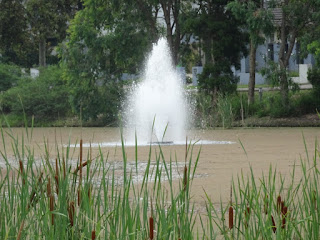
Across the Lake, on the other side, is a deck overlooking the Lake.  We walked across a wooden bridge to reach the deck, which housed a double-sided chair dedicated, in memorial, to a past citizen.  We sat there for a while, listening to the sound of water as it rose up like a fountain in the centre of the Lake and watched the tiny droplets, shimmer like diamonds, as they descended in a silver spray.  Now and then we saw a fish rise to the surface before diving below.  I saw a dragonfly, hover in mid air, before landing on a tall bullrush by the edge of the lake.  There is a gabion wall at the back of the deck, to stabilise the shoreline.  This provides a good home for lizards, ants and other insects amongst the nooks and crannies between the rocks in the wire crates.

The native fern Azolla is growing on the surface of the Lake.  It floats in a pink mass on top of the water by means of numerous small overlapping scale-like leaves, with their roots hanging in the water.  It  changes from green to pink in the sun.
A water spout in the middle of the Lake seems to be keeping the Azolla under control, as it ensures the water is constantly churned up and moving. The fern can grow very quickly.
Here is the swimming pool  in the Sanctuary Community Centre for the Waterside Estate.  It was a hot day in Summer, yet there was nobody in the pool!  I wonder why?
The Sanctuary Community Centre is situated at the far end of the Lake.  There were two people using the tennis court on our visit to the Centre, but no children in the playground.  It seems a shame if these facilities are not being used.
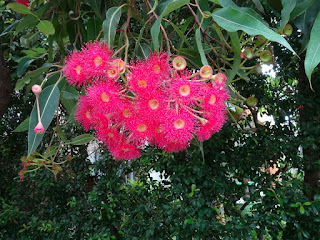
We noticed this beautiful flowering Gum tree in the front yard of a property in Knot Street facing the Lake.  The flowers are very pretty.  They look like little tutu skirts that the *Gumnut babies might wear.  Flowering gums are grafted Eucalyptus trees   They make great feature trees in small yards and attract nectar hungry birds.   

We enjoyed our walk around this small lake with many features to take our interest.   In future weeks we shall look for other Lakes to explore in Waterside Estate.


Acknowledgments

1.  Wikipedia (for information about Azolla)

2. Flower Power (for information about Eucalyptus trees)

3. *The Gumnut babies are Snugglepot and Cuddlepie, children's books written by May Gibbs and loved by generations of Australian children.

Friday, 4 February 2022

Waterside Estate, Cranebrook

 Kingfisher Park

It was a typically hot Summer's day in Penrith with the thermometer already climbing above thirty degrees Celsius.  The temptation to stay home in our cool air-conditioned Unit was high, but the desire to get out and do a bit more exploration of our new neighbourhood was greater.  After all, Waterside Estate was just a ten minute drive from our place and the delights of discovering new places to visit in this Lakeside Estate were irresistible.  We had already discovered the Lakes Walk and had walked around the first of the five Lakes, so this time we decided to look for Kingfisher Park along the shores of another Lake in the Estate.

It was a little bit tricky finding our way to this Park as I have not yet mastered how to use the GPS in my new car.  I  prefer to rely on the old-fashioned method of actually studying a map beforehand and working out how to get to my destination!  However, I did not have a map of this fairly new area, so I had to rely on Google maps on my mobile phone.  I find using my fingers to expand the map challenging, as I tend to lose sight of the street I am studying when my fingers enlarge it and it pivots out of control getting bigger and bigger until it disappears off the screen!  I managed to write down some rough directions on a piece of paper and handed it to Ken, who was acting as my navigator.  

Unfortunately, Ken found my directions a bit too rough so I had to pull over in the car every now and then in order to decipher my writing and work out what street was next.  Eventually we arrived in Avocet Court and saw a sign announcing it was indeed Kingfisher Park.

The heat hit us as we stepped out of our cool car, but we were excited to see what lay ahead.  There is a grassy area and children's playground facing the street, as well as a barbecue area and then a track leads down to a bridge crossing a lake.   

This is the sign Kingfisher Park on the corner of Avocet Court and Spinebill Place.   We could see the water of the Lake shimmering through the trees, as we walked down the leaf-strewn path towards the bridge.  We stopped to admire the views and then walked over to the other side of the Lake.
A number of water spouts are in the Lake which helps keep the water moving and controls the native red azolla from growing.  Azolla is a floating native fern growing on the water in the Lake.  It is  non toxic, but seems to grow quickly and changes green to red when exposed to the sun.
We saw this grand Australian Eastern Water Dragon moving along the shore of the Lake.  He had a very long tail which was far too long to fit in this photo!  We saw other lizards and many birds amongst the wildlife of the Lake and were happy to see the wildlife thriving.
Walking along the track, we had a good view of the Lake.  There are also plenty of seats along the track where people can rest and enjoy the scenery of this beautiful Park.  Down one end there is a pretty waterful where we saw more lizards.
Here are the houses along Waterside Boulevarde, across the bridge and on the other side of the Lake.  They are all modern two-storey homes with glorious views of the Lake.

We enjoyed our walk in Kingfisher Park and hope, in the coming weeks, to discover more Parks and nature reserves in the beautiful Waterside Estate, such a sparkling jewel in the crown of Sydney's western suburbs.

Acknowledgments

Donna Carroll -  Manager, Robinson Strata & Community Association 22.1.2015 (information on Red Azolla).

Saturday, 29 January 2022

Cranebrook

 The Lakes Walk, Waterside Estate

On Sunday 16 January, Ken and I drove to Cranebrook and parked our car in Laycock Avenue to explore part of the Lakes Walk.  It turned out to be a much longer walk than we anticipated and we also managed to get lost!  The weather was very hot, over 30 degrees Celsius and foolishly we left our bottle of water in the car, so we were dehydrated and exhausted by the time we made it back.

The Lakes Walk is a leafy and shady track that meanders by the shores of five Lakes and waterways in the Waterside Estate at Cranebrook.   Waterside Estate is a new Lakeside neighbourhood in the heart of the Penrith Valley and not far from the International Regatta Centre, all very close to where we live.  After the heavy rain lately, excess run-off water has flowed into the Lakes.  This water is rich in nutrients which act as food for algae and parts of the Lakes are covered in Blue green algae.   Even though algae is an aquatic plant that occurs naturally in all aquatic habitats, this appeared to be out of control and parts of the Lakes looked as though grass was growing on the water.  

The first part of the walk was very pleasant, but then the track led us out on to a suburban road, which confused us.  The houses facing the Lake in this road are modern two-storey terrace style houses with nice gardens and lots of shady trees.  It did not look like a typical Australian suburban street, but the houses are probably architecturally designed with energy efficient solutions for living in the hot climate of Western Sydney.  It looked a nice place to live.  We turned right along the footpath, continuing over a road bridge to the other side of the first Lake and kept walking down the footpath.  We lost sight of the Lake, but hoped we would eventually come to a track we could follow to take us back there.  

The footpath suddenly came to an end with a barrier across it and beyond the barrier there was a grassy slope down to a road below.  I thought at this stage it might be best to try and retrace our steps, but Ken was keen to keep going forward and get down to the road.  We walked down the steep slope, which took us out on to a hot country road in a rural Cumberland Plain woodland where Grey Box Eucalypts and Forest Red Gums dotted the landscape.  We had obviously left the Waterside Estate and were lost!   

We were now both feeling very hot and dehydrated.  We wanted to sit down and looked around vainly for somewhere to rest!  Ken was very red in the face and I guess I must have looked the same to him.

We saw a young woman coming towards us as she walked her dog along the road, so we went and spoke to her.  

She was friendly and helpful in providing directions that would get us back on track to the Lakes Walk.  However, she said her car was parked nearby and she offered to drive us back to our car.  I was certainly tempted by her kind offer, but we declined as her dog was not very happy at having his walk interrupted.  He was whining and refusing to turn around and walk back to the car.  I took pity on the poor animal, as he was missing a hind leg and the walk was probably the highlight of his day!   We assured the woman we would be OK once we were back on the shady lakes walk.

We thanked her and said good-bye, then walked down the road until we came to the track she had pointed out to us.  It was good to get out of the sun and back into the shady tree lined Lakes Walk.   This final walk took us longer than expected and I was wishing we had accepted the woman's kind offer of a lift, but eventually we  made it to the point where we had entered thus completing our circumnavigation of that first Lake.  

This bridge was the first one we crossed, after we entered the Lakes area from Laycock Avenue.
There were several water spouts in the Lakes, which look very pretty and assist  in keeping the water moving.  They also provide algae control.
Here is a crop of blue green algae growing on the surface of the water.  Exposure to blue green algae can cause skin and eye irrations in people who are sensitive.  However, I'm sure nobody would want to swim in the Lakes during an algae infestation.
This young Purple Swamphen (Porphyrio porphyrio) was very friendly and came right up to us.  Obviously, some of the birds are used to getting scraps of food from people passing by.  However, there were signs up requesting people not to feed the wildlife.
The Lakes are a very peaceful spot and a cool retreat on such a hot day.

By the time we finally made it back to our car, we were dry in the mouth and gasping for a cold drink of water.  We had left a bottle of water in a cooler bag in the car, so thankfully, we had a nice cool drink to quench our thirst and revive us! 

We decided next time to make sure we were better equipped for walking and carry backpacks containing essential items such as water, snacks, cameras and first aid kit.  We had not expected the walk to take so long.

We shall be back as there are more Lakes and parks to explore in this area.


Acknowledgments

1.  NSW Government Blue Green Algae Fact Sheet.

2.  Waterside Your New Home by the Water.  Stockland.


Tuesday, 18 January 2022

Cranebrook

 Grey Gums Oval, Cranebrook

On Sunday 9 January we set out to explore a little bit more of our new neighbourhood.  We drove to Grey Gums Oval in Cranebrook, not far from our home and parked the car at the entrance to the Oval on Grey Gums Road.  We then walked past the grandstand, down the hill to an area set aside for the newly created wildflower meadow.  

Penrith local City Council was granted funds under the NSW Government's Greening the Great West Walk Programme and they have used these funds to create a temporary wildflower meadow called "Let it Bee".  The project has been designed to improve the inferior clay soil so that 78 new trees can ultimately be planted.  These trees will boost canopy cover and help in reducing temperatures along the Walk by creating some welcome shade. They will also provide shelter for local wildlife and help enhance biodiversity.  The Great West Walk is a 65 km walk from Parramatta to the base of the Blue Mountains.  

Here is the path inside the gate.  As the gate was locked we left the car on the grass beside the entrance to the Oval.  Maybe the gate is kept locked on days when there are no sporting events taking place, but it was a shame we couldn't drive in and park in the car park.
There were beautiful flowers growing in the wildflower meadow including Bulbine bulbosa, Calotis lappulacea, Pultenaea villosa and Wahlenbergia. These flower species have adapted to Penrith's soils, temperatures and climate over millions of years.   
One of the many bee "hotels" set up in the wildflower gardens.  We saw many butterflies and birds flying amongst the flowers whilst we were there.  These bee hotels provide fun for the children and are also an educational experience.
The flowers will be cultivated back into the soil next May 
This is the area set aside for the wildflower meadow.  In the middle there is the framework of a bee and flower seeds have been planted in it.  There were park benches placed along the pathways where you can sit and enjoy the gardens. 
Seeds from the flowers will be collected for propagation in Council's nursery.
There were many Ibis birds gathered on the Oval.  After the recent rain, the Oval was quite wet with lots of pools of water and this obviously was an attraction for these waterbirds.  From a distance it looked as though the Oval was covered with a flock of sheep!


We enjoyed our time spent in the wildflower meadow.  I was pleased that our local Council is environmentally conscious and involved in a programme to improve our local area and, at the same time, educate the population about climate change and what can be done about it.  Over the coming Summer weeks, we hope to explore a little bit more of our new neighbourhood.  I am especially keen to explore a little bit more of the Penrith Lakes area.

Acknowledgements

1.  Inside Local Government.

2.  Penrith City Council

3.  Australasian Leisure Management

4.  The Western Weekender.