Labels

Friday, 23 August 2019

Auburn

Auburn Cherry Blossom Festival

Yesterday on 22nd August, 2019 we caught the train down to Auburn and then boarded a bus bound for the Auburn Botanical Gardens for the annual Cherry Blossom Festival.  It was nice to be back in familiar territory, as we once lived in Auburn and remember when the Gardens were first opened  on the site of an old rubbish disposal area.  The Gardens have come a long way since those first days and the trees are now all well established and it is a particularly peaceful and  inviting place to be.  However, at this time of year when the Cherry Blossom Festival is on, it is overrun with visitors and we decided that next time we visit we will choose a quieter time when not so many people are crowded on the pathways.  It was nice to see the Cherry Blossoms in full bloom, such a magnificent sight.

The Auburn Botanic Gardens were established in 1977 and covers an area of 9.7 hectares.  There are two lakes, a waterfall and bridges.  Duck River winds through the Gardens.  Some of the paths are narrow and it was a bit hard to manoeuvre with so many people on the path yesterday. 
The Gardens have been beautifully landscaped and it is an oasis of both man-made and natural beauty in the middle of suburban Sydney.
 A view of the Lake in the Japanese Garden.  The Garden features traditional Japanese landscaping with beautiful decorative red bridges, ornamental trees and flowers.  The Lake has ducks, Geese and Koi carp.
 Lots of people looking at the row of Cherry Blossom trees through the Japanese archway.  It was Seniors Day and there were lots of older people on the paths with walking aids, wheelchairs and walking frames!
Some of the beautiful Cherry Blossoms, giving a magnificent display along the pathway.  In Japanese culture, the Cherry Blossom symbolises the fragility of life and its beauty.

There are a range of activities and entertainment in the Gardens throughout the nine days of the Festival, including demonstrations of Ikebana (flower arranging) Kendo (Martial Arts), various musical performances including Koto and Taiko drumming and also examples of the fashion subculture Cosplay.


Wednesday, 7 August 2019

Yarramundi Reserve - continued

North and South sides

We walked for quite a long way on the Southern side of the Reserve but, as Ken was getting tired, we decided to turn around and head back.  It was also lunch time and we were hungry.  The path is very good, except for the beginning where the ground is covered with pebbles.  When we returned to the entrance, we took a little path to the right and explored this for a little way.  It seems to run alongside the Southern Lagoon and we shall come back and explore this at a later date.  We then walked back to the car and drove the short distance to the Northern side of the Reserve.  We enjoyed a picnic lunch in one of the picnic sheds beside the river.  We took a short walk after lunch to explore a little of the Northern side, but as we were quite tired by now, we decided to drive back home.

I'm not sure whether this gate is ever used, or if it is just decoration.  However, it looked rather cute along the path.  There was a gatepost on the other side, so maybe it is used when needed to block access to the path.
There were lots of black swans on the Southern Lagoon.  It must have been their lunch time, because they were all busy dipping their heads under the water and I was lucky to get these three on a break in their feeding.
A fork in the road. I have been wanting a picture for the cover page of my song  "A Fork in the Road".  This will be ideal!  "Along the dusty road I walked, until I came to where it forked and, undecided I stood there, to contemplate both ways with care".  The idea for the lyrics is based on the poem by Robert Frost "The Road Not Taken".
The sandy beach beside the Northern side of the tidal Grose River.  This is a popular spot for families on weekends during the summer, as kiddies can enjoy paddling and swimming in the river.  It is also a dog-off-leash area and dogs are permitted to play and swim in the river.
This is the sign at the entrance to the Northern side of Yarramundi Reserve.  There are picnic facilities in this area, a toilet block and a sandy beach beside the river.  The river is quite shallow in places and it is possible to walk across to the other side and into Navua Reserve at Grose Wold.

Tuesday, 6 August 2019

Yarramundi Reserve

Where the Rivers Meet

Today we took a little trip down the bends of Hawkesbury Road and along Springwood Road to the Southern section of Yarramundi Reserve at the confluence of the Grose and Hawkesbury-Nepean Rivers.  This is one of our favourite places and it was nice to get out and enjoy a bit of fresh air and sunshine, as Ken has been quite ill with the 'flu and felt like a little excursion to cheer him up.  We took a picnic lunch, which we enjoyed after our walk along the river path by the Southern Lagoon.

Here is part of the river on the Southern side of the Reserve.  Due to the abundance of native wildlife within the Reserve, the Southern portion is managed as a Conservation Zone and Wildlife Refuge.
There were Pelicans cruising along the river, as well as Black Swans and Ducks and Herons.
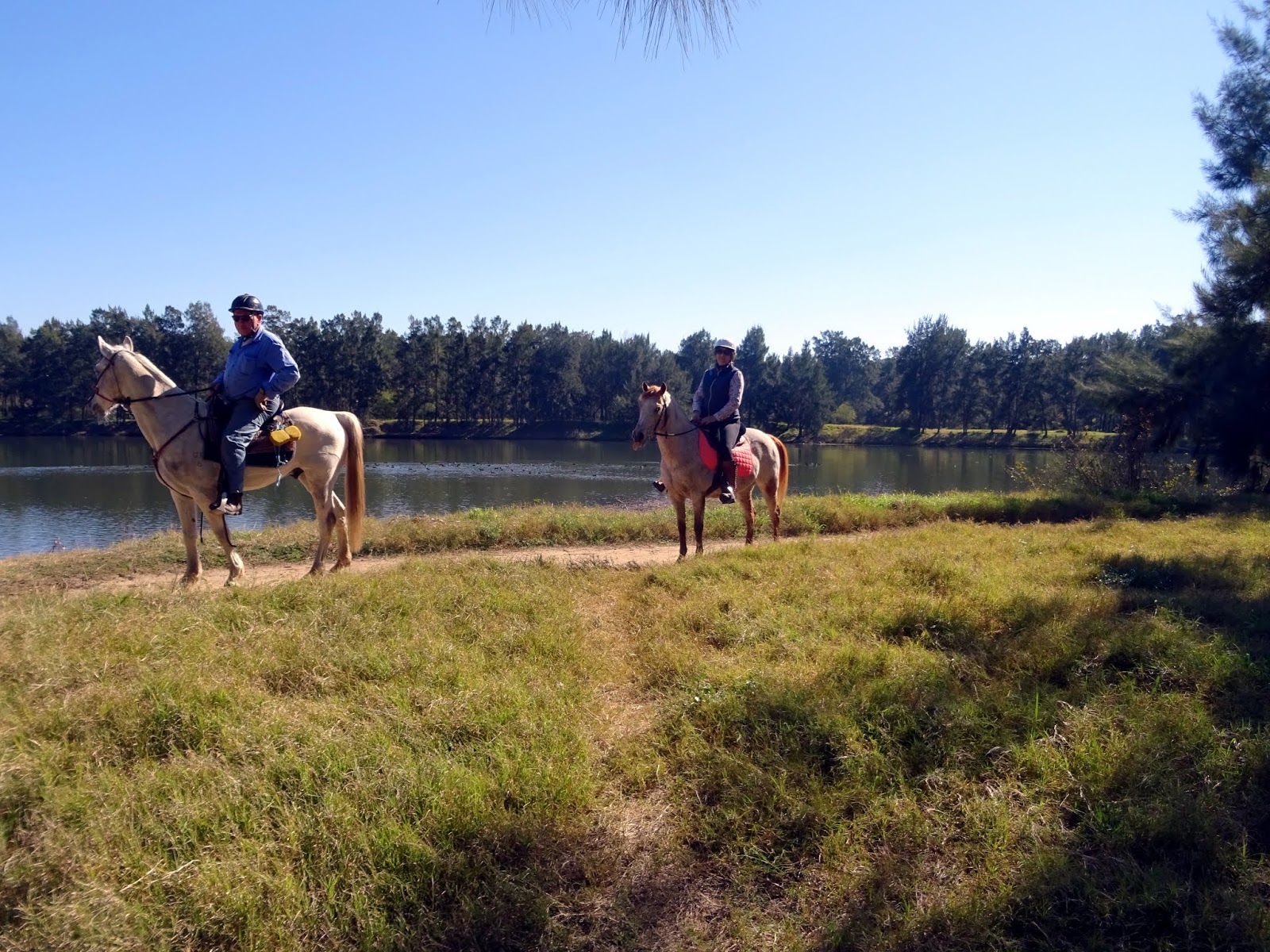
We saw some people riding their horses along the river path.  They stopped to say "G'day!".  We saw them later, on their return and they told us to look out for the bats!
 Looking across the Southern Lagoon towards the Blue Mountains.   Our home is perched along the top of Winmalee Ridge.  I like to think it is somewhere within the range of this view!
Here is the colony of  Grey-headed Flying Fox, which our horse-riding friends told us about.  Evidently they periodically visit this Reserve and are well known for their wide ranging foraging habits.  They feed on the fruit, nectar and blossom of eucalypts and rainforest plants.  Due to habitat clearing, they are listed as a vulnerable species under the Threatened Species Conservation Act.


Birdwatchers can view a variety of woodland and wetland birds within the reserve. Over 93 different species have been recorded, including Ducks, Herons, Eagles, Doves, Parrots, Wrens, Honeyeaters and Finches. The reserve is also very popular for fishing, with at least 14 species of fish known to live in the area, though not all of them are suitable for fishing. You may find Bass, Catfish, Eels, Mullet and Gudgeons in these waters, as well as exotic fish such as Carp and Goldfish also occur here. 

Friday, 28 June 2019

Scenic Rim, Queensland

Summer Land Camel Farm

On Tuesday 25 June we visited the Camel Farm at Harrisville in the Scenic Rim district in South East Queensland.  The camels are ones retrieved from Central Australia where there are plague proportions of camels just wandering around in the desert.  Summer Land has professional cameleers who train the wild camels and people can enjoy riding these strong, stable, gentle and intelligent beauties each with their individual personalities.  The rides are on tandem saddles for a traditional camel caravan ride.  The property has stunning natural beauty with an abundance of native flora, fauna and birdlife.  There is also a cafe and retail store on the farm where you can sample the dairy products such as camel milk, cheeses, gelatos, chocolate, delicious camel meats and charcuterie, cakes and camelccino.  There are also anti-aging skin care products and I bought a small jar of lip balm.

There were many Camels who came to greet us, especially when they saw we had purchased bags of grass which they devoured when we held out a handful for them.
There are over 500 Camels on the property.  Summer Land began in 2015 when the Government began a culling programme targeting wild Camels.  These Camels were rescued from a gruesome fate. 
This is the shop and cafe where we purchased some retail products and also bought some gelato ice cream.  Summer Land is Australia's largest Camel dairy and Wild Camel Training Centre.  Camel milk is also good for the skin.
Here is my bowl of strawberry gelato ice cream which was delicious.  Studies have shown that Camel Milk has many nutritional benefits and is thought to be the closest milk to human breast milk.


Thursday, 27 June 2019

Milora

Tamborine Mountain

To-day we took a drive to Tamborine Mountain in the picturesque Hinterland of the Gold Coast.  We drove through lush rainforest to reach the top of the Mountain, a place popular with hang-gliders.  We had lunch at the Fortitude Brewing Co. where they serve meals, as well as brewing their own range of beers.  After lunch we continued to drive around this picturesque area

The view from Tamborine Mountain.  There were some hang gliders there, soaring high up in the air after taking off from a grassy slope
 A spectacular view over the surrounding countryside.  We then drove back down to the Scenic Rim region to a town called Boonah and stopped for a coffee at Cafe 17.  Boonah is a very pretty place in an area bustling with farms producing produce for the Brisbane markets.
Back at the farm the chooks were in the chook pen, waiting to be fed and let out for a scratch around outside their cage.  We were lucky to get a couple of eggs.
Some of the cattle on the farm, grazing on the stubble.  There is drought up here and rain is desperately needed.  The dam is almost empty and the cattle now have to be hand fed with hay.
Two water tanks on the property that take up bore water for using as grey water in the laundry and toilets.

Wednesday, 26 June 2019

Milora

Down on the Farm 

Last Thursday 20th June, we travelled by Qantas plane to Brisbane and were met at the airport by Ken's daughter Diane and her husband David who drove us then to their farm in the Scenic Rim region of South West Queensland at Milora near Ipswitch.  We spent four days on the farm enjoying a little bit of country life and a big family get together on Saturday when grandchildren and great grandchildren arrived to welcome us.


Inside David's shed which he has constructed to house memorabilia of old utensils used around the district long ago.  It is a fascinating place to explore and a historical record of life in a bygone era.
Here is a view of the homestead with a Wattle tree ready to burst into bloom.  The house has a sweeping view of the surrounding countryside.  My bedroom had a sliding door on to this front verandah which was a great place to sit and enjoy the winter sun.
There are lots of rusty old farming equipment placed as sculptures throughout the garden which add a country vibe to the property.  This old tractor stands in the garden along the front driveway.  Zoe, one of the great grandchildren, had fun playing on this with Delilah (the dog) when she arrived on Saturday.
This is a view of Munbilla Road from the front of the property.

Here is the front driveway looking down, over the cattle grid, to the woodpile which is near the front entrance to the property.  David and his brother are splitting the wood and chopping it into sizeable logs and bagging it for firewood, which they are selling.  He also keeps wood for the combustion stove in the house which is kept burning all day and night to keep the house nice and cosy.

Thursday, 13 June 2019

Leura

Sorensen's Glasshouse and Gardens

Today we drove up to Leura to visit a new venue, Sorensen's Glasshouse and Gardens at 8 Herbert Street, Leura.  This is on the site of renowned Danish-born landscape gardener, Paul Sorensen's original house and garden.  The Glasshouse is set on two acres of heritage listed gardens which still need a lot of replanting and work to bring them back to their original glory.  The work is being undertaken by Alexandra Munro and her partner, John Klugt describing the Glasshouse as their “dream business”.  They have leased it from the owner 


The couple has transformed the former nursery into a beautiful cafe/shop.  They have also employed a gardner to restore the gardens where the master plantsman, Paul Sorensen, once ran his nursery.  The site has been subdivided and twenty townhouses developed next door.

Paul Sorensen established the nursery in 1920.  He raised his family in the house on site and planted hundreds of cool climate trees in the arboretum, which he designed to give customers an idea of what mature specimens would look like.  The nursery finally closed in 1989, six years after Sorensen's death.
  
When Alexandra and John took out the lease, the Glasshouse was a complete mess and they spent five months stripping it out and refitting it into what is now a bright airy space selling locally made wares, greeting cards, skin care products, plants, etc.
The food, in the cafe, is fairly simple, as there is no kitchen on site.  There are teas, coffee, cakes and light snacks as well as soup and hot pies.  There are also ready-made picnic baskets for sale for eating in the garden, when the weather is suitable.
After lunch, we took a drive to some of our favourite lookouts in the Mountains.


Above is a view of the escarpment, taken from the track to the Sublime Point lookout in Leura.