Labels

Saturday, 26 October 2019

Bathurst - continued

Beekeepers Inn, Vittoria

After leaving Abercrombie House last Thursday, we drove on in the bus to Vittoria, on the outskirts of Bathurst to have a delicious lunch at The Beekeepers Inn.   The Restaurant & Cafe is licenced to serve local wines, ciders and 1859 brand beer.  The meal consisted of contemporary Australian cuisine using seasonal produce and ingredients.  The Inn was originally a Cobb & Co. stopover.  It was built in 1859 and is now a tourist destination operated by the Lockwood family.  There is also a farm shop attached to the cafe with a range of local and regional quality foods.  There is also a unique range of Goldfields varietal honeys available for tasting and purchase in the farm shop.  Through a glass window we could watch the live bee display as the bees brought nectar back to the hive. 


The sign on this building said The Beekeepers Inn, but I think it may just be an old shed on the property that has been converted into a museum with a collection of Australiana from the days of Cobb & Co. and the gold rush days.  I didn't take a look inside as I was more interested in inspecting the large range of Irises on display in the adjoining Iris Farm.
There is an Iris Farm on the property called  Antonia's Irises.  Here they grow Bearded Irises on site and the early varieties were in full flower.  There were many different varieties and colours.  This one was called DeLovely.  The names of all the irises were displayed at the end of each bed.

Many geese, ducks and other waterfowl were wandering around the dam on the property.

After leaving The Beekeepers Inn, we drove back to Bathurst and did a lap on the Racing Circuit at Mount Panorama.  The Bathurst 1000 Motor Race is held here in October every year.
A view from the top of Mount Panorama on the racing circuit.  Our driver stopped the bus, so we could get out and take photographs from on top of the Mountain.

We then drove back into the township of Bathurst.
All Saints Anglican Cathedral in Bathurst.  We stopped for a little while here, but disappointingly, we could not see inside the Church, as it was locked. 

Opposite the Cathedral is a beautiful Park named Kings Parade containing the War Memorial Carillion which is a memorial to the soldiers who lost their lives in the two World Wars.

We left Bathurst about 3.30pm to head back to the Blue Mountains and home after a great day out.

Friday, 25 October 2019

Bathurst

Abercrombie House, Bathurst

Yesterday we travelled to Bathurst and visited Abercrombie House.  Abercrombie House is a country family mansion, in the Victorian Tudor style, built of granite stone with sandstone dressing to the quoins and window surrounds.  It sits high on a hill, with a panoramic view overlooking a broad landscape.  The house has a prominent, stepped and gabled slate roof with traceried windows and an octagonal spire and stone balustrade porch.  It was built by the Stewart family, who were Bathurst pioneers.  William Stewart was the Lieutenant Governor General of New South Wales and was granted the land in Bathurst as a reward for doing his job well.

 
Abercrombie House is of great historical significance and is listed on the National Trust Register, the New South Wales Heritage Register and the Australian Heritage Database.  There are two storeys and an attic floor.  The building's most striking feature is its array of curvilinear parapeted gables, topped by iron finials.
The 50 acre land and house is currently owned by the Rex Henry Morgan family.  Since 1969 the Morgan family has made major restorations to the house.  The house is currently occupied by Christopher Morgan and his family.  The young Christopher can remember when his family brought the house and growing up in this 50 room mansion.  Every room had to have a purpose and items of furniture were bought, at auction, to furnish the rooms.  There are many pianos throughout the house and even a pipe organ in the Gallery above the Dining Room.

This is the long wrap-around front verandah, where we sat at a table and enjoyed a lovely morning tea.  The floor is paved in a traditional design of  tessellated tiles.
 There are many unusual decorations on display throughout the house.  This Chinese Dragon was in the entrance hallway as we entered the house.  On the opposite wall was a wooden carved elephant.  It was a very hot day outside, but beautifully cool inside.
Part of the landscape from the front gate looking  towards Bathurst.  After we left Abercrombie House we set off to have lunch at the Beekeepers Inn  

Thursday, 26 September 2019

Bowral

Corbett Gardens, Bowral

After leaving Camelot on Tuesday, we continued on to the Southern Highlands town of Bowral to see the Tulip display in Corbett Gardens.  Over 90,000 Tulip bulbs are mass planted to present a spectacular Spring display.  Corbett Gardens is a small public park at the entrance to Bowral where Tulip Time is an annual event.  This year the author of Mary Poppins, PL Travers (real name Helen Lyndon Goff) was a featured theme. The inspiration for writing the Mary Poppins stories came to the author whilst she was a teenager telling bed time stories to her younger sisters, when they lived in Bowral.


A beautiful garden bed filled with masses of Tulips.  This bed had mixed varieties.  On the left is the Senior Citizens Tea Rooms with tables and chairs spread out along the bank of the little stream, a perfect place to relax and enjoy the sunshine and flowers.
This magnificent Weeping Cherry Tree was in full bloom and looked amazing.  Many visitors were dressed in Spring fashions and National Costumes so they could pose to be photographed amongst the Tulips. 
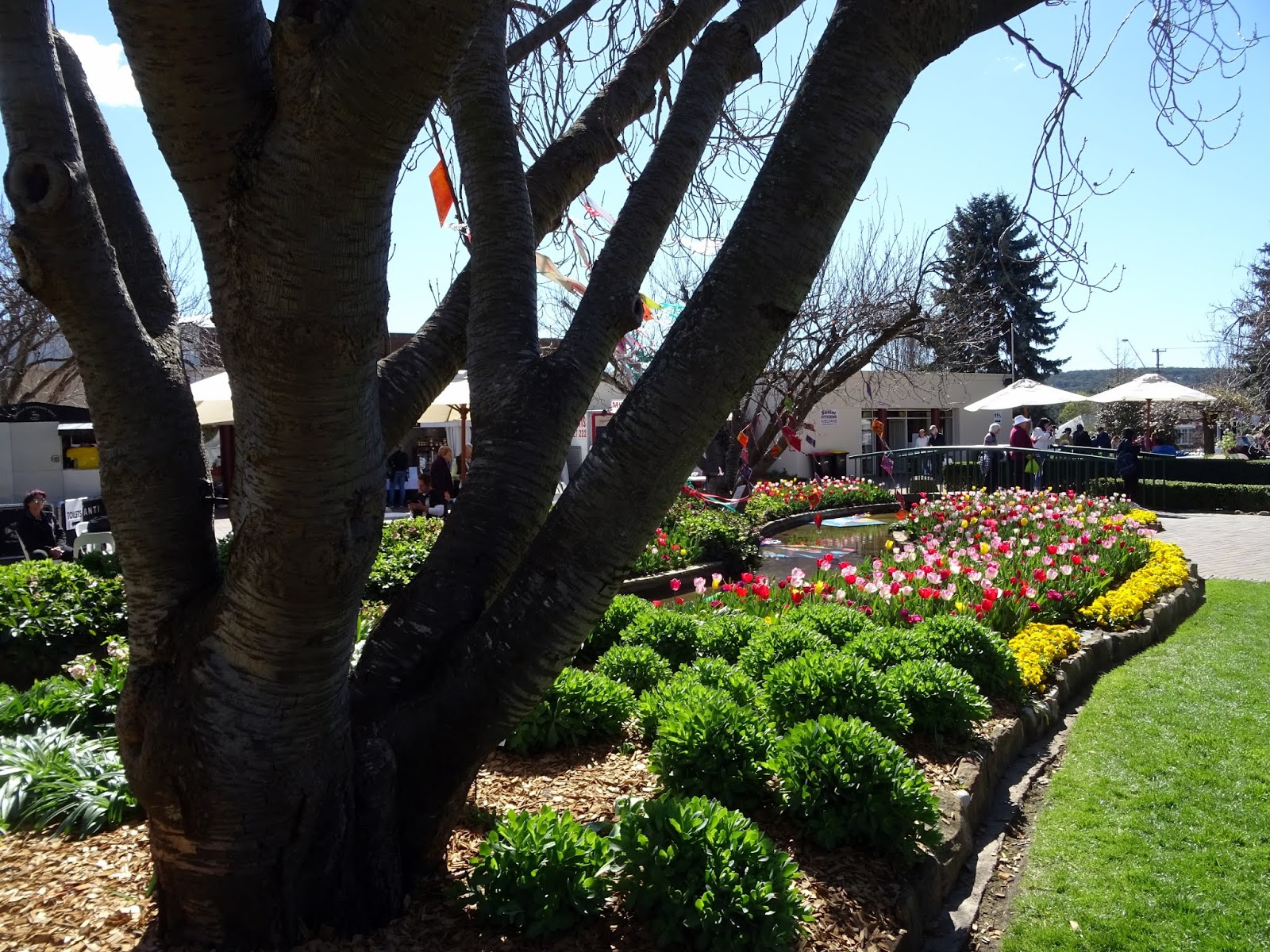
Another view of the Gardens from beneath the Kanzan Cherry Tree.  There are many lovely old trees growing in the Gardens, including Japanese Maples, Red Oak, Maidenhair Tree, London Plane and Himalayan Cypress.
Mary Poppins ready to "take off" under her open  umbrella.  It is 85 years since PL Travers wrote about the perfect Nanny, Mary Poppins.
The chimney stacks forming the silhouette of Old London Town, part of the Mary Poppins theme.  Hamilton and Leen Van Der Mark Tulips are on display beneath the chimneys.
A lovely pot of pink Tulips along one of the pathways. There were many such pots placed around the Gardens with magnificent displays of the many varieties of Tulips.

We were lucky to have a bright sunny day to see the Tulips.

Wednesday, 25 September 2019

Camden

 A Place to Call Home

Did anyone ever watch A Place to Call Home a drama TV series on Channel 7?  Those of you who did, will remember the beautiful house featured in that series called Ash Park where the Bligh family lived.  Well yesterday Ken and I did a trip down to the Southern Highlands and on the way we called in at Camelot a grand house on the outskirts of Camden and, guess what folks?  This was Ash Park where the filming of this drama series took place.  There it was, in all its romantic glory.  Little turrets, chimney stacks, gables and balconies silhouetted against a backdrop of drop-dead gorgeous countryside.  It was just like a magical fairytale where, at any moment, I could picture Noni Hazlehurst, as Mrs Bligh, stepping down the front steps to greet us to her home!

Camelot was originally built in about 1883, although more likely to have been 1888.  It has 55 rooms and a network of long passageways, steeples, garrets and towers and many ornate fireplaces.  Some hundreds of thousands of bricks were used in the building and a reservoir was built on the hill and water pumped from the Nepean River.
This is the main entrance, front door and gravel driveway.  The actors in the television series all used this main entrance for their scenes in the show, arriving in the glamorous cars of the era.  The present owners of the house, Brendan Powers and his wife Rachel Powers. bought the property in 1999 and are lovingly restoring it to its original glory.
This is the beehive shaped Smokehouse, for smoking meat.  It has not been used for more than 50 years, but the owners now have plans to bring this back into production.  The house behind was built for the architect and builder to live in while Camelot was being built.  It is now just a shell inside, although the owners' son is slowly renovating it.
 A small corner inside the house showing an ornate Hall Stand and chaise lounge.  The distinctive arched windows are a feature of the architecture of the house.  The Architect was John Horbury Hunt and in his time was one of New South Wales' most brilliant architects.  He trained under the colony's leading architect, Edmund Blackett.  John Horbury Hunt arrived in Sydney in 1863 aged 24.  He was born in Canada.
A view from an upstairs verandah over the surrounding countryside.  The Razorback Range can be seen in the distance.

Camelot remains today much as it was more than 90 years ago.  An extra turret has been added since 1937 to enclose the upstairs sunroom.

Surveyor, John Oxley in the early days of British colonisation, received a 600 acre grant of land outside Camden where he built Kirkham, the site of today's Camelot.  The original Kirkham was demolished and in its place the present home was built.  The only Oxley building to survive today is the Kirkham Stables, built in 1816.

Wednesday, 28 August 2019

Yarramundi Reserve - Re-visited

South Side Lagoon

After lunch today we drove down to Yarramundi Reserve again.  We decided to do the short walk around the Southern Lagoon that we did not do three weeks' ago.  It was slightly overcast as we set off along the path through the Woods, but the sun soon came out and it became quite warm as we continued on our way.  This short walk soon petered out!   We came to a Notice announcing it was  private property and we were not allowed beyond the fence.  This was disappointing, as we were hoping to continue further.  Reluctantly, we turned around and walked back to the starting point and then walked a short distance along the longer track, that we did the other day.  We saw many different birds and had a great time trying to capture them on our cameras.  The little woodland birds were so quick, but we were happy to see a new bird for us, the Red-browed Finch.

Looking down the Nepean River from the confluence at Yarramundi Reserve.  Three Rivers meet at the Reserve.  The Grose River, the Hawkesbury River and the Nepean River.  
Here's the beginning of the walk through the Woods beside the Lagoon on the South side of Yarramundi Reserve.  It looked so promising at the start and the Woods looked dark and mysterious!  We saw some people fishing along the banks of the Lagoon.
 An old abandoned boat, looking the worse for wear, by the bank of the Lagoon.  I wonder what stories it could tell!  Who would leave a boat to rot by the river?
Here is one of the Red-browed Finch that we saw flitting through the undergrowth and on the path.  There were several of these birds, but they were so quick and hard to capture. The Red-browed Finch is most easily recognised by its bright redeyebrow, rump and beak, on an otherwise green and grey bird. Upperparts are olive green with grey underneath.
An Australian White Ibis on the banks of the River.  It was nice to see the Ibis in his natural environment and not scavenging around a rubbish bin in a suburban park!  They are called "bin chickens" in the city, where they are known for their scavenging habits.  They are great survivors and, as their natural Wetlands are slowly being denuded, they have acclimatised themselves to city living!

Our walk today was fairly short, but it was good to be out in the fresh air and enjoying the natural world.

Saturday, 24 August 2019

Auburn - continued

Cherry Blossom Festival - continued

We spent a pleasant morning wandering around the Gardens.  While we were in the Japanese Garden, we saw several Peacocks strutting around and fanning out their magnificent tails.  I was thrilled to see these fantastic, colourful birds. We then made our way to a billabong, where we sat down on a park bench and watched the waterbirds gathered on a little island in the middle of the water.  By now it was after midday and we were beginning to feel hungry, so we made our way to the food stalls and bought some Japanese takeaway and then a cup of tea at another stall and sat down by the Pool of Reflection to have our lunch.

A beautiful Peacock strutting along the path, happy to mingle with the visitors.  These birds add an exotic touch to the Gardens.  The male Peacocks use their tails to perform mating rituals and courtship displays.
A Japanese Teahouse by the side of the Lake and jutting out over the water.  There were lots of little porthole windows where you could peek through and get a good view of the ducks and geese on the water.  The Teahouse made a nice little garden room with benches along the sides where you could rest or have a picnic.
A Dusky Moorhen walking around on the little island in the middle of the billabong.  There were lots of birds around the billabong and also up in the air and in the trees around the water.
Here is part of the waterfall at the far end of the Lake in the Japanese Garden.  We stood on a little decorative bridge, in front of the waterfall  and watched the water cascading down under the bridge and into the Lake. 
There were plenty of food stalls, selling mostly Japanese takeaway food.  We chose some delicious krispy chicken on satay sticks and also some prawn and vegetable gyozas.  There was also a kiosk selling tea and coffee.

After our lunch, we decided to catch the bus back to the station as the weather was becoming cold and a strong wind was blowing.  We were glad we had been able to attend the Cherry Blossom Festival and found it most entertaining.  The bus trip to and from the station was also interesting as we were able to see all the places that were so familiar to us after living for 28 years in Auburn.  It has certainly changed a lot since we left 17 years ago.

Friday, 23 August 2019

Auburn

Auburn Cherry Blossom Festival

Yesterday on 22nd August, 2019 we caught the train down to Auburn and then boarded a bus bound for the Auburn Botanical Gardens for the annual Cherry Blossom Festival.  It was nice to be back in familiar territory, as we once lived in Auburn and remember when the Gardens were first opened  on the site of an old rubbish disposal area.  The Gardens have come a long way since those first days and the trees are now all well established and it is a particularly peaceful and  inviting place to be.  However, at this time of year when the Cherry Blossom Festival is on, it is overrun with visitors and we decided that next time we visit we will choose a quieter time when not so many people are crowded on the pathways.  It was nice to see the Cherry Blossoms in full bloom, such a magnificent sight.

The Auburn Botanic Gardens were established in 1977 and covers an area of 9.7 hectares.  There are two lakes, a waterfall and bridges.  Duck River winds through the Gardens.  Some of the paths are narrow and it was a bit hard to manoeuvre with so many people on the path yesterday. 
The Gardens have been beautifully landscaped and it is an oasis of both man-made and natural beauty in the middle of suburban Sydney.
 A view of the Lake in the Japanese Garden.  The Garden features traditional Japanese landscaping with beautiful decorative red bridges, ornamental trees and flowers.  The Lake has ducks, Geese and Koi carp.
 Lots of people looking at the row of Cherry Blossom trees through the Japanese archway.  It was Seniors Day and there were lots of older people on the paths with walking aids, wheelchairs and walking frames!
Some of the beautiful Cherry Blossoms, giving a magnificent display along the pathway.  In Japanese culture, the Cherry Blossom symbolises the fragility of life and its beauty.

There are a range of activities and entertainment in the Gardens throughout the nine days of the Festival, including demonstrations of Ikebana (flower arranging) Kendo (Martial Arts), various musical performances including Koto and Taiko drumming and also examples of the fashion subculture Cosplay.