Labels

Friday, 31 July 2020

Yellow Rock - continued

Yellomundee Regional Park - continued

This is an update on my blog post yesterday.  Our friend has identified the artist we met yesterday as John Rice.  I discovered his facebook page at https://www.facebook.com/johnriceart/ and was thrilled to find he had put up a photo of his painting yesterday, so I have re-produced it here for you to see.  John is an energetic outdoor painter and enjoys painting landscape from life "en plein air" and makes regular painting trips around the countryside.  He also conducts regular workshops.

After leaving the Lookout yesterday we drove back along the bumpy road, negotiating the potholes very carefully, until we reached the bitumen and proceeded into the residential section of Yellow Rock.  We drove down Illingworth Street until we came to a little park.  We parked the car in the street and proceeded to walk into the Park.  We had been to this place before and we wanted to check out the mosaic wall again and make sure it was still intact.

Here is the painting Ken saw as John Rice was preparing to pack up and leave.   I was not able to walk down to the spot where John Rice was painting, but I did see the painting when we spoke to him on his walk back to his car.
 And here is the painting that John Rice put up on his facebook page today.  As you can see it is exactly just as we saw it yesterday.  He has not yet added any further colour to it.
Here is part of the mosaic wall in the little playground park in Yellow Rock.  I like the Black Cockatoos.  I believe there are Black Cockatoos in the area, but I have not yet seen any in real life.  Plenty of Kookaburras, King Parrots and Rainbow Lorikeets, of course.  There is even a little possum up in the left-hand corner!
This is a little tile path of stepping stones that takes you through a bush garden and leads to the mosaic wall at the back of the Park.
 Different animals were stencilled on to the concrete path.  I liked this one of a Kangaroo.  There was also an Elephant, Lion, rabbit, cat and cockatoo and probably others that I missed!
We had wanted to see some Wattle blooming and found this little bush by the side of the road.  We were a bit disappointed at the poor displays of Wattle.  Maybe, it is still a bit early for them to be out.  Another week or two and there should be plenty.  It reminded me of a song my dad used to sing when I was a child and later when I was in choir we also sang this song.  It is called  "The Wattle Song" written by Warren Fahey.

"The bush was grey a week today,
Olive green and brown and grey,
But now it's changing all the way,
With blossoms for the wattle.


It seems to be a fairy tree,
Dancing to a melody,
Sing a little song to me,
The graceful, swaying wattle."


Thursday, 30 July 2020

Yellow Rock

Yellomundee Regional Park

Today we drove down Singles Ridge Road to Yellow Rock.  The end part of this road that leads down to the lookout at Yellow Rock has deteriorated badly, with huge potholes, and I was fearful for our car in negotiating these hazards.  We do not have a four wheel drive so we drove very gingerly along it.  I don't think we will visit here again for a while, not until the road is repaired!  It was a beautiful sunny afternoon and the view, as always, looked spectacular.  There was an artist painting the view and he had captured the scene very well.  He said it was his first time at this spot.  I was hoping to see some wattle blooming in the bush, but there was nothing visible.  I was not able to walk very far as the terrain is very rocky and I am suffering with a painful knee at the moment.  Ken did a little exploratory walk around the area.

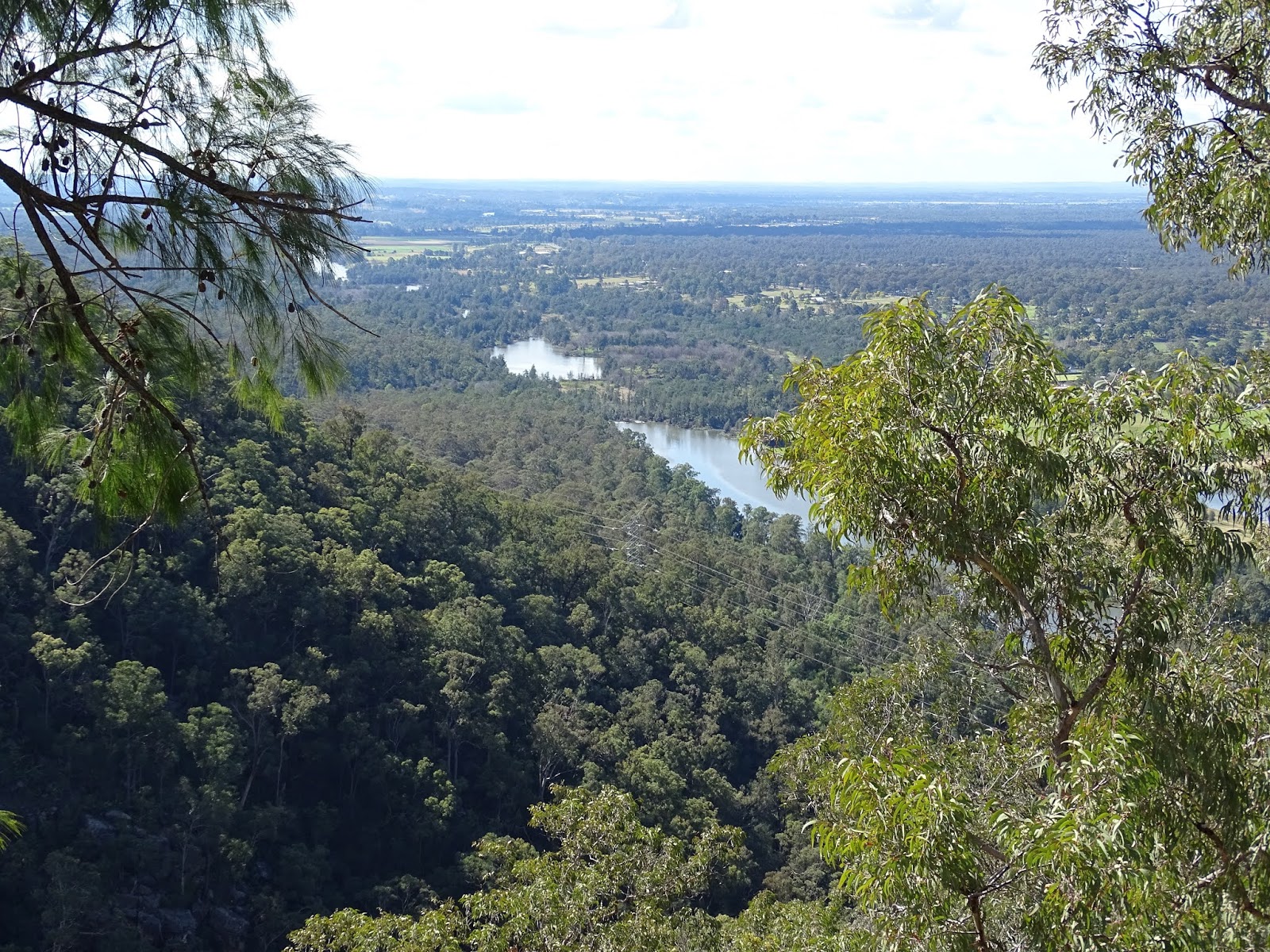
Here is the spectacular view from the lookout, looking down to the Nepean River.  The Yellomundee Regional Park is located on the Eastern escarpment of the Blue Mountains
Here is the artist, all packed up and ready to head back to his car.  He lives in Mulgoa.  You can see the painting attached to his easel.  I thought it was very good.  He said he thought it was a bit too light and would have to add some colour to it when he got home to his studio.  I think he had been painting all morning.
This deep chasm between two rocks looks rather scary.  I always think of the movie Picnic at Hanging Rock when I see dark crevices like this between rocks.
Part of the badly potholed road that leads down to the lookout.  I think four wheel drive vehicles are partly responsible for the deterioration of this road, as I can imagine, when they see a dirt road, they delight in driving fast along it, with little regard to how they rip up the surface!
Here I am resting by a tree.  The terrain was very rough and I was not able to explore very far without hanging on to Ken for support!


After leaving the lookout area, we drove around the streets in the residential area of Yellow Rock.  Yellow Rock is quite an isolated settlement in the Blue Mountains.  There are no shops, but there are many nice homes in neat suburban streets.

Friday, 10 July 2020

Randwick

St. Jude's - 4th Sunday after Trinity 5 July, 2020

During these Covid-19 days, when all Churches have been closed for Sunday worship, we have had to make other arrangements regarding our church attendance.  In normal times we like to attend Christ Church, our local Anglican Church in Springwood, but during the pandemic the Church has had to conduct church services via Zoom.  Although the Ministry team is doing a great job in maintaining the continuity of worship, the zoom style of service has a few drawbacks, so we have looked around for an added alternative.  We found St. Jude's at Randwick on You Tube where our friend Andrew Schmidt is the Rector and we have been happy to partake in this online service every Sunday since the beginning of the pandemic.  Andrew was once an assistant minister at Anglican Churches in Springwood and we feel he is a good friend and we are familiar with his preaching, so we feel quite at home in this beautiful Church.  We have actually been inside this Church as we attended Andrew's induction a few year's ago when a busload from the Springwood congregation journeyed over to Randwick to attend the induction and supper afterwards in the Church hall.

Here is the beautiful church of St. Judes, Randwick.  There are differing views as to who was the Architect, among them being Simeon Pearce and Edmund Blackett.  The foundation stone was laid in 1861.
Rev. Andrew Schmidt at the beginning of the service on Sunday 5 July, 2020.  Every week there is always a beautiful flower arrangement beside the prayer desk, on the communion table and by the organist.
Kat Cowell, Women's and Families Minister, reading the Gospel.  She is married to Nigel Cowell, a student minister at St. Judes.
Rev. Andrew Goddard (Assistant Minister, Youth and Evangelism) delivering the sermon on Sunday 5 July, 2020.  Here, in the background, you can see the pipes of the organ. 
Andrew Schmidt giving the blessing at the end of the Holy Communion service.  There is also another Minister on the Ministry team, Rev. Jim Le Huray.
Angus Gilchrist the organist always plays a glorious postlude at the end of the service, which is a treat to listen to. Angus is also the choirmaster and every Sunday there is a small representation of the choir, socially distanced, to sing the hymns and vocal parts of the Dudman mass.

We enjoy partaking in this service on You Tube on our TV, sitting in our comfortable lounge chairs  with the gas fire on, joining in by saying the responses and singing the hymns.  We also appreciate the opportunity to take communion online and always have our bread and wine, in tiny glasses, set out on a little table in front of us.  Because the service is available on You Tube, we can watch it at a time convenient to us and we choose to watch it after we have watched our own church's service on zoom on Sunday morning.  We feel we are doing the best we can in these uncertain times and are just grateful we are fortunate enough to be able to access these meetings due to modern technology.

Saturday, 20 June 2020

Faulconbridge

Chapman Parade

On Thursday 18 June we set off to do a short bushwalk to Springwood Creek.  According to our information the entrance was from Boland Road or Bednal Road, Springwood.   The approach to Boland Road was a left hand turn off the Great Western Highway heading East and as we were driving on the Highway heading west, we decided to try the Bednal Road  entrance.  However, the entrance was on a steep bend in the road and it was not possible to park the car anywhere near the entrance.  We decided to scrap this walk and instead headed for Chapman Parade, Faulconbridge past the Norman Lindsay House and Gallery.  We drove along Chapman Parade as far as we could, until the bitumen ran out and it became a dirt track.  We parked the car and headed out on foot along the dirt track.

We parked our car by the side of the road, outside this property's open gate. There was a large clearing for cars to turn around and head back, as the dirt track ahead was only suitable for 4WD vehicles.  We set off, through a forest of burnt tree trunks from past bushfires.  The trees quickly regenerate with new foliage, but the trunks remain scarred.
 After the recent rain, there were large puddles of water all along the track and we had to tread our way carefully through the undergrowth and side diversions along the track.  Fortunately, the track was fairly level.
Well, this seemed almost a lake!  I love the reflections of the trees in the muddy water.  There were muddy tide marks caked on the trunks of the trees along the edge of the lake.  Any vehicle crashing through that water would leave a layer of splashed up mud on the trunks.
 As it is winter there were not many wildflowers blooming, but we did see a few Banksias and some Wattles beginning to blossom.  Another month and the bush should be full of Wattle in flower.
Garden fugitives!!  This is what happens when people dump garden refuse in the bush.  This little clump of Agapanthus could get out of control before too long!  I like Agapanthus flowers, but the bush is not the place to see these non-native flowers.
We turned back at this point.  My leg was beginning to ache and we had no idea how long the track was and even if it went anywhere.

I did a little bit of research after we arrived back home and discovered that the dirt track at the end of Chapman Parade is a favourite destination for 4WD vehicles.  The track is horrendous in parts, with a few little steep rocky sections that would probably require a winch, but I guess a lot of fun to off-roaders.  I watched several videos of vehicles negotiating this track and I must say it looked pretty scary!

While we were walking along the track we had to step aside as three 4WD vehicles drove by.  They barely acknowledged us and seemed pretty intent on concentrating on the road.

The bush seems to be a dumping ground for rubbish, but I noticed at least one 4WD club was organising a Clean-up day and asking their members to participate in a cleaning up the bush day and requesting they bring trailers to help cart the rubbish away and take it to the tip.  It's good to know they are trying to get the bush back to a pristine state, even if they are tearing-up the track!

Thursday, 4 June 2020

Glenbrook

Glenbrook Lagoon - Turtle Island

Yesterday Ken and I drove down to Glenbrook to visit the Lagoon.  We were here last January and wanted to see how the new Turtle Island was progressing.  At the time of our last visit I was not aware of the significance of the raft we saw floating out on the Lagoon, but I am now fully aware of the nature of this raft.  It is an eco habitat to provide a safe nesting place for turtles.  The project is a collaboration between Blue Mountains City Council, Western Sydney University and local volunteers.  I believe already three nests containing eggs have been found on the floating nesting place, known as Turtle Island.  Glenbrook Lagoon is home to a number of turtle species, including Eastern Long-neck and Sydney Basin turtles.  The turtles face danger, as foxes destroy 95 per cent of their nests so the  island will provide an excellent refuge.  The island contains nest boxes, sand, turf and soil.  The turtles find the materials they like and nest.  The island can hold up to 30 nests.  The floating island will make it harder for foxes to get to the eggs.

Glenbrook Lagoon is a haven for remnant bushland.  It is an active bushcare site and a valued recreation point for the community.  There is a lovely track through the bush and along part of the Lagoon.  It is not possible to walk completely around the Lagoon and at some point the track links up with local streets.
This was our point of entry from where we parked our car.  We were surprised at how cold it was and the trees looked dark and gloomy.  The water level in the Lagoon was much higher than it had been when we were last here in January.
Here is the floating raft known as Turtle Island.  Foxes are able to swim, but it depends on their motivation.  If there is an abundance of food on land then there would be no reason for them to swim out to the island.
This is part of the track, running along the back boundaries of houses in the area.  This track eventually meets up with a local residential street.  However, it is a quiet area and we saw some ducks waddling safely beside the road.
This is part of the remnant bushland.  We were quite shocked at the state of this bush as there were lots of logs and trees lying around and we thought it looked ill-cared for.  However, there may have been a reason to leave the logs and branches in that state as they would provide habitat for the local fauna and other insects and creatures.


We enjoyed our little trip to the Lagoon again, but it was a cold afternoon and we had not brought coats with us, so we did not spend very long outside.  We drove around the Lagoon and stopped to view it at various entry points along the way and then hurried back to the warmth of our car.

Wednesday, 20 May 2020

Richmond

Pugh's Lagoon

As home isolation restrictions have now been lifted, Ken and I decided to drive down to Pugh's Lagoon yesterday to enjoy a walk in the Autumn sunshine around this beautiful Reserve, which is also a sanctuary for the local waterbirds.  It was also an ideal opportunity to try out my new camera.  I have bought the latest Sony digital compact cyber-shot 30x up to 60x optical zoom with wi fi connect to my smartphone.  It replaces my old Sony camera, with similar features, which I wore out after 5 years of constant use.  It simply wasn't worth trying to get it fixed as I figured technology would have superseded my old camera. 

Smith Park, opposite the Lagoon.  It seems a rather plain name for such a beautiful place.  However, I guess it was named after somebody historically important to the area.  Pugh's Lagoon is named after Edward Pugh, a convict transported to NSW in 1787 and later granted 100 acres west of Richmond, including this Lagoon.
Three Geese stepping out and getting ready to cross the road in the car park.  There are lots of Geese and Ducks wandering around, also Purple Swamphens and Eurasian Coots. 

It was not a good day to try out my new camera as the sun was very bright and I couldn't see the image on my digital screen. 
More Ducks waddling along on the banks of the Lagoon.  There are grassy banks and mature trees creating a peaceful recreational space.  There are also many picnic sheds and a concrete path around the lower section of the Park.
I love the reflection of the trees in the beautiful blue water of the Lagoon.  Pugh's Lagoon is considered an ecological wetland and is home to many plant and bird species. There are normally many black swans on the water, but we did not see any yesterday.
These trees, in full Autumn splendour, made a lovely reflection in the water.

Many of the mature trees in the Park are not native species, but more suited to English parklands and were probably planted at a time when the early settlers wanted to create a landscape more familiar to them.
Up on a hill overlooking the Lagoon I spied this interesting looking house.  I love the twin chimneys and the high pitched roof, reminiscent of a house in the English countryside.

Pugh's Lagoon is part of the Hawkesbury Artists trail and has been depicted in art by many artists in the Hawkesbury region.  The Lagoon has been painted by Charles Conder, impressionist artist, during his time in Richmond.  The oil on cardboard painting "A Shady Hollow by a Dusty Road" depicts the area in 1887.

We enjoyed our visit to the Lagoon as it is one of our favourite places.  We drove back along Springwood Road and up the bends to Hawkesbury Road, pausing to look at the view from Hawkesbury Heights Lookout.  There were lots of visitors to the Lookout, everybody eager to get out for a while.


Tuesday, 5 May 2020

Winmalee Ridge

Winmalee Ridge

On Monday 4th May, for our exercise, whilst practising self isolation during the Covid 19 pandemic, we took a bushwalk to Winmalee Ridge.  This is a short walk from our house into a track through the bush out to the ridgeline bordering Winmalee.   We took advantage of the pleasant weather to venture a little further than the residential streets and do an actual bushwalk.   However, in getting to the place where the bushwalk begins, we need to walk down a very steep residential street called Shakespeare Drive, so we decided to drive the car to the beginning of the bushwalk as we did not want to face the steep climb back up Shakespeare Drive before getting back to our house on Hawkesbury Road.


We left the car parked along the roadside and proceeded on the walk through the bush.  It was a beautiful sunny Autumn day and very pleasant walking through the bush.  The track was quite well defined in the early stages, but seemed to branch out into different directions after a while.  There is a wire fence running along one boundary and we could not venture into this area, which belongs to the Winmalee Sewerage Works.

There were many tall trees and lots of Angophoras in the process of shedding their bark revealing lovely smooth pinkish trunks. These trees are commonly known as the the smooth-barked apple.
Surprisingly we found there were a number of wildflowers blooming.  Here is a Lambertia formosa,  commonly known as the Mountain Devil and there were a number of these in flower.  Also some early Wattle, especially Acacia ulicifolia commonly known as Prickly Moses.  This little Wattle is found all through the Blue Mountains on sandy soils and heathland.  There were also lots of different varieties of Banksias.
The Banksia flowers were dotted around everywhere and I love their upright stiff bristle like appearance.  Some were small and others thinner and taller.  There were some Banksia serrata trees out on the rock platforms, with their grey knobbly bark and big black banksia seed pods dotted along the branches and it is these pods that helped to inspire May Gibbs write about her big bad banksia men in the adventures of Snugglepot and Cuddlepie in her books for children.
Here is a tree, hollowed out by a bushfire.  These hollow trees provide resource or habitat for all  kinds of animal life and are an important part of the ecosystem.

We did not notice or hear any birds in the bush which was disappointing as I am a great lover of birds and like to photograph them in the wild.  Maybe it was just as well as I did not have my camera with me and was only relying on my phone camera, which would not have been good enough to zoom in on the birds.
I couldn't identify this little wildflower with its dainty white flowers.

About 8 years' ago I did a Native Plant Recognition course at the Wentworth Falls TAFE and did several field trips into the bush to identify various plant species.  I loved this course and would have gone on to do more, but unfortunately the Government pulled the funding of TAFE courses at the time and the opportunity was not there to go any further.  However, I still have my text books and will try later to identify this plant.  (Edit: Could be Epacris pulchella)
Banksia spinulosa, a hairpin Banksia in the Proteaceae family.  It grows from a lignotuber with multiple stems.  The leaves are linear, narrow and a couple of millimetres wide.  There were lots of these bushes with their stiff golden yellow spikes lighting up the bush like candles.

The bush seemed to be in very good condition with no sign of any weed infestation.  There were however, several sticks and branches which would have blown down in the recent very windy weather, but nothing that was not too difficult to step over!

We made it to the highest point on the Ridge which was a large flat rock perched on the edge of the ridge overlooking
Frasers Creek and in the distance the Nepean River, which we could not see.  At this point we were 299 metres above sea level.

We continued a little bit further along the track, but then it seemed to peter out, so rather than risk getting lost and not being able to find our way back, we turned around and walked back to our car after a very enjoyable little exercise break.