Labels

Sunday, 27 June 2021

Sydney

St. Andrew's Anglican Cathedral, Sydney

To-day is the first day of the Greater Sydney lockdown, caused by the spread of the Covid 19 virus.  We are confined to our homes for the next two weeks.  As it is a Sunday and we are not permitted to attend Church, we watched the 10.30 am service of Morning Prayer at St. Andrew's Cathedral in Sydney, live streamed on our TV.

There were no parishioners or worshippers in the Cathedral and just a skeleton staff to attend to proceedings.   The Leader was Chris Allan (Acting Dean), organist (Ross Cobb), bible readers, singer, preacher Rev. Garry Dibley from CMS and camera technicians. They all did a great job, but I did miss the choir.  

Because the Choir was absent, all the hymns were sung by a solo singer and he did a magnificent job.  The words to all the hymns were on the TV screen, so it was easy to sing along to these well-known hymns - "God of grace and God of Glory", "I heard the voice of Jesus say" and "Can it be".

This is the outside view of St. Andrew's Cathedral, Sydney.  The Cathedral  faces George Street, next-door to the Town Hall.  It is Gothic Revival architecture designed primarily by Edmund Blacket from 1837-1868.  It is built in Sydney sandstone and is the oldest cathedral in Australia.
This beautiful seven-light and four tiered stained glass East window above the communion table is a complex composition depicting scenes in the life of Christ at which the apostle Andrew was present, such as the Feeding of the Five Thousand.
The organist up high in the organ loft.  The organ is an amalgamation of two organs, one by William Hill & Sons (1866) and another by John Whitely (1929) and restored by the Canadian firm Orgues Letoumeau.  During non-lockdown times there are regular lunchtime organ recitals.
Rev. Christopher Allan, the Acting Dean of Sydney.  He said the Cathedral will be closed to the public during the current lockdown and all services will be on-line only, for the time being.
Rev. Garry Dibley delivered the sermon.  He preached on Acts 9: 1-20 the dramatic conversion story of Saul on the road to Damascus.  

Saul was travelling on the road, looking for followers of Jesus to take as prisoners, when a light from heaven flashed around him and he heard the voice of Jesus speak to him, asking, "Why do you persecute me?"  He was then struck blind and had to be led into Damascus by the men travelling with him.  

After three days a man named Ananias placed his hands on Saul and said that Jesus had sent him to heal him and immediately scales fell from Saul's eyes and he could see again. He was then filled with the Holy Spirit and baptised.

Rev. Garry said it was never too late to be saved by Jesus.  God has the power to use even the hostile persecutor to achieve his divine purpose.

We enjoyed being able to watch the service in the comfort of our own home and felt grateful that modern technology enables us to watch and partake in Church services by joining in with the responses and the singing of hymns.

Acknowledgments

1.  Wikipedia
2.  St. Andrew's Cathedral website.


Thursday, 24 June 2021

Emu Plains

The Lewers Cafe and Art Gallery

We have had family from interstate visiting us and, on Tuesday, we all had lunch at the Lewers Cafe at 86 River Road, Emu Plains.  This cafe is now part of the Penrith Regional Art Gallery which is set in the former home of Australian Artists Gerald and Margo Lewers.  These leading artists were part of the development of modernism in Australian art.  After Gerald and Margo died, their home was gifted by the Lewers family to the people of Penrith as the Lewers Bequest, with the vision to create a centre of excellence for the presentation and appreciation of art for the community.  The Gallery regularly presents exhibitions, workshops and special events, both inside and outside in the beautiful gardens surrounding the home.  The gardens are maintained by heritage gardeners with seasonal vegetables grown and used in meals served in the cafe.  The Gallery is in a picturesque location along the Great River Walk facing the Nepean River on the Emu Plains side.

We had lunch first, before exploring the Galleries and garden.  We started with drinks and I had a Miss Ginny cocktail, followed by a lunch of Roast lamb with crispy polenta and vegetables which was delicious.

There are three galleries to explore.  One is in the original homestead of the artists and this is called Lewers House.  The second one is Ancher House built as a granny flat for Margo Lewers' mother and the other is a purpose built gallery, with a gallery shop, at the end of the cafe.

This picture was taken looking through the windows at the back of the Gallery at the end of the cafe and looking into the heritage garden.  The garden has many exotic species of plants and succulents.  The original house was built in 1905 and was bought by the Lewers in 1942.  Several of Gerald's sculptures are placed in the garden.
These paintings are hanging on the walls in Ancher House. This house was  designed by architect Sydney Ancher for Margo Lewers' mother, who died as the house was being completed.  Margo won recognition as a leading postwar Abstract expressionist.


This beautiful stained glass window is a fanlight above the front door of the house and a similar window is also above the door at the end of the hallway.  The sidelight windows beside the doors had similar designs and were also stained glass windows.
A French Window inside the house.  This window is actually a door and is opened by sliding it upwards.  You can then step outside on to the verandah and out into the garden. 
This artwork is in the present exhibition being shown in the Gallery.  It is by Ada Bird Petyarre, an indigenous artist who lived in a community 230km North East of Alice SpringsAda worked in both painting and batik.  Her work has been exhibited nationally and internationally and collected by major galleries around the world.  She was part of an early indigenous art movement.

There was also artwork by another exhibitor, Dr David MiddlebrookDavid is a landscape artist who works in pen and ink, sepia and large oil paintings.  His work revolves around the horizon  which he views as a drive to strive for the unobtainable.  He likes to explore the impact of the horizon in different media.

For the last three years of Ada's life, Ada and David Middlebrook were friends and their friendship changed David's concept of landscape.  Ada liked to look at David's drawings  and if she recognised the landscape she would sing it.  For David, this brought his drawings to life.  David collaborated with Ada while he was undertaking research for his PhD degree and his thesis was on exploring the horizon.

The current exhibition is called Bird Petyarre & Middlebrook and opened on 15 May and will conclude on 22 August.  It is well worth a visit.

After our walk around the Galleries we stepped out into the garden, admiring the many different species of plants.  We enjoyed our visit to the Penrith Regional Gallery and the historic Lewers home, very much.  

Acknowledgments

1.  Art Atrium website
2.  Penrith Regional Gallery website
3.  Wikipedia.
4.  "Looking at or being landscape" by Dr. David Middlebrook

Wednesday, 16 June 2021

Epping

 St. Alban's Anglican Church

Last Sunday I attended the Christening of my great niece Chloe in St. Alban's Anglican Church, at 3 Pembroke Street, Epping.  Epping is a suburb of Sydney, situated in the local Government area of Parramatta and on the Northern line of the Sydney Trains system.  Wallumedegal Aboriginal people were living in the region of Epping when the Europeans arrived.

St. Alban's is a very beautiful Church in a leafy suburban street near the train station.  On entering, I was impressed with the number of magnificent stained glass windows.  There is also a pipe organ half way down the Church, placed aloft in the West Gallery. The Font, where the baptism took place, is situated down the front of the Church and I sat in a pew directly in front of the Font and consequently had a good view of the christening.  The Church follows an Anglo-Catholic tradition, rare for a Church in the Diocese of Sydney.  There were many candles flickering in the Church and also on the altar and Chloe's family later were given a christening candle lit from the Paschal Candle.   

I was interested to find out about the history of this Church, but unfortunately I have not been able to find out very much.  I did ascertain however, that the Church first began with services in the home of Robert Hilliard in 1891.  In 1892 he built a wooden hall on his property where church services then took place.  The first Church on the site was erected in 1896, with the present Church opened in December, 1923.  Many additions and alterations have been made over the years since then.  

I believe there are now plans to demolish the Church Hall, Rectory and all other buildings on the site, except the Church itself and to erect two twin towers of sixteen storeys each.  The Church wants to capitalise on its land value and height limits which allows buildings of sixteen storeys.  The Church is going into partnership with a developer, granting a long term lease to the developer while still retaining ownership of the land. The towers are planned to provide about 150 homes and opportunities for better community services for the growing multi-cultural area.   

Here is a photo of St. Alban's showing the tall Church tower,  However, this will be dwarfed when the new twin towers are built on the land.    

The land is 100 metres from Epping Station and the Church feels that it could better serve the wider community.  The lower floors of the Towers could include office space and retail outlets, such as cafes.
Here is another view of the Church, but I could not get back far enough to include the tower at the side of the Church.  I was standing back as far as the gate through to the Rectory.  It seems a shame that the beautiful Rectory will also be demolished.
There are many beautiful stained glass windows in the Church.  They looked particularly beautiful with the early morning sunlight streaming through them.  Some are memorial windows to parishioners who died in war battles.
Here is the Holy table or altar.  There was a Holy Communion (Eucharist) after the christening where the congregation knelt or stood at the altar rails to partake of the bread and wine.  
Here is Chloe with her family, gathered around the Font being baptised by Father Paul.  This was the first Christening at the Church since the outbreak of the Covid pandemic.  

Father Paul sprinkled holy water from the Font on to her head and marked it with the sign of the cross.  He declared that she live as a disciple of Christ, fight the good fight, finish the race and keep the faith.  The congregation then responded, saying Confess Christ crucified, proclaim his resurrection, look for his coming in glory.

After the service, we had morning tea in the Church Hall, mingling with members of the Church congregation and then departed for a family luncheon with Chloe's family in their home.

I was so pleased to attend Chloe's Christening and to know her parents intend to raise her with Christian values and beliefs.

Acknowledgments

1.  The Northern District Times
2.  St. Alban's with St. Aidan's website.
3.  Hornsby Shire Council website.  


Friday, 14 May 2021

Penrith

 St. Stephen the Martyr Anglican Church

On Wednesday 12th May, Ken and I drove up High Street in Penrith to investigate the local Anglican Church in our area with a view to attending services there in the future.  Penrith lies in Darug country and the Darug people, in pre-colonial times, survived as skilled hunters, in family groups or clans and were scattered throughout much of what is now modern day Sydney.  Since moving to Penrith we have not yet found a Church we can join, due in part to the present pandemic and the rules regarding mask wearing and congregational singing.

The Church was named after St. Stephen, a Christian Deacon in Jerusalem, stoned to death in 36 AD for blasphemy and the first Christian martyr.  He is the patron saint of deacons and stonemasons.

There is a Cemetery situated behind the Church which is fenced off from the Church, but we were able to gain access via a side road.  Some of the graves were in a very poor state and quite dilapidated.  The grass was also quite high and not very well maintained.  I believe the placement of the Cemetery is quite unusual being so far away from the Church.  Most graveyards attached to Churches are quite close, but this one had a car park and Church hall in the immediate vicinity and the graveyard was a fair walk away.   

The Church is Gothic in design and built of local sun-dried brick, but as it began to crumble, it was cement rendered in 1906 both inside and out.  The foundation stone was laid in 1837 and it is the 15th oldest surviving church in New South Wales.
St. Stephen's occupies a commanding position in High Street and would have once been in the centre of the little village of Penrith.  However, the shift has now gone further down the hill  around the train station and Westfield shopping plaza. The Church's thirteen metre tower would have been a landmark for early travellers  to the area.  
Here is a statue, in the Cemetery of St. Stephen's, of an angel, looking heavenwards, on top of a monument "in loving memory" to W.D. Matthews who died in 1892.  

The last burial in the Cemetery took place in 1943.  The most important burial is that of Dr. Sir John Jamison (1776 - 1884).  He was a significant citizen in the early days of the Colony.  Jamison Road is an important road in the Penrith area and we often drive down it as it leads to the river.
There are two tall Palm trees in front of the Church facing High Street.  They are magnificent specimens and add an exotic touch to the streetscape.  I think they would have been considered exotic plantings at the time, in line with Australia being seen as a Botanical jewel in the South Pacific.
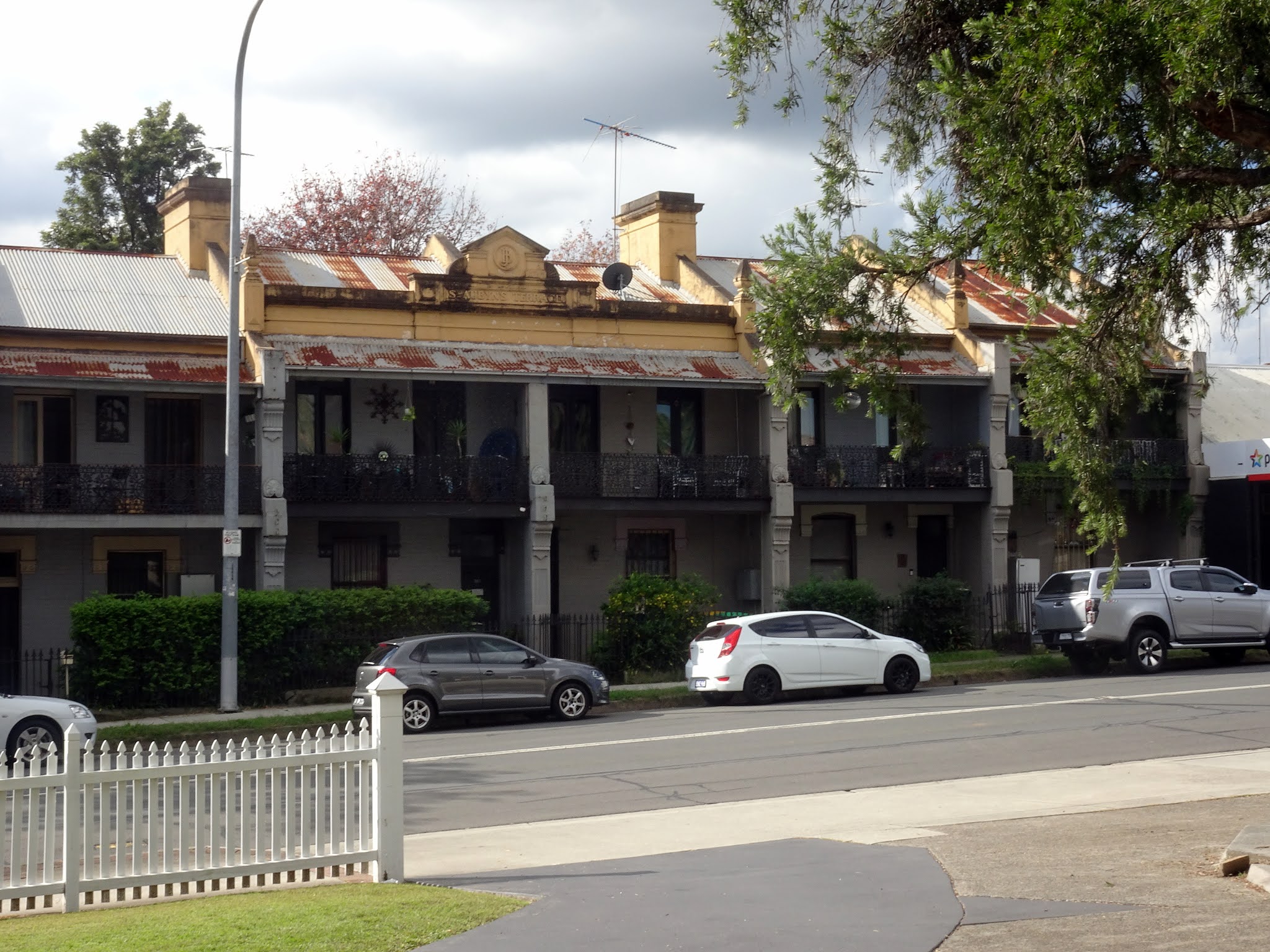
St. Aubyn's Terrace at 255-265 High Street comprising six double-storey terraces lies opposite St. Stephen's Church.  They were built and owned by English born John Brown (1809-1888) who was the father of bushranger James Buckley Brown.  John Brown also owned the historic Emu Hall on the banks of the Nepean River.  His initials "JB" are on the central parapet of St. Aubyn's, visible from the street.


I am not sure when and, if we will attend this Church in the future.  I would like to see inside, especially as I know it has a pipe organ.  The vestry door was open and Ken took a peek inside, but I was hesitant to do so and shortly afterwards a van drove up and parked outside.  It was an electrician, returning to do some work inside the Church.


Acknowledgments

Acts of the Apostles in the New Testament (Chapters 6 & 7)

Penrith City Library.

Wikipedia


Monday, 5 April 2021

Werrington

 Werrington Lake Reserve

On Good Friday, after lunch, we took a short drive to the Werrington Lake Reserve.  It is not far from our new home and we were thrilled to discover this delightful little Wetland Reserve which is a haven for the local native wetland birdlife and fauna and flora.  It is a man-made Lake developed in the 1980's as a solution to the flooding problem of the Werrington Creek.  It is a perfect spot for a family picnic with large open spaces, barbecue and toilet facilities, outdoor gym equipment and bicycle and walking tracks.  There is also a shaded children's playground with swings, climbing equipment, fireman's pole, monkey bars, spring rockers and a slide and water jets where children can cool off in the summer.

Penrith City Council has constructed the walkways, bridges, wharves, playgrounds and landscaped  around the vast complex.  It is an ideal place for students undertaking wetland and water conservation studies, but it is also a great recreational area with many picnic tables and seats dotted throughout the parklands. The Lake is used as a wetland to filter stormwater before entering the Werrington Creek  and it is also used for irrigation of the nearby cricket ground to the west and surrounding parklands.

It was a beautiful sunny afternoon and plenty of people were out and about enjoying being outdoors on the first day of the Easter holiday weekend.

We set off on the walking track around the Lake, admiring the beautiful scenery and water views, stopping every now and then to photograph the birds and wildlife.  There were plenty of seats at intervals along the track where we could take a rest.


The Lake is surrounded by tall gum trees and small native bushes, although I did notice a lot of weed infestation.  We saw ducks and other birds feeding and playing around the shores.  There are fountains of water spurting up in the Lake and a little island in the centre which adds to the visual appeal.


We saw this Eastern Water Dragon basking in the sun beside the path.  They are native to Eastern Australia.  They have long powerful limbs and claws for climbing.  They are able to swim totally submerged and rest on the bottom of shallow creeks or lakes for up to 90 minutes to avoid detection.   Their tails comprise about two-thirds of their total length.


There were lots of water birds resting on the little island.  The birds are relatively safe on the Island, free from most predators.  Human contact is not possible on the Island, save maybe from someone swimming over there!


A group of Ibis birds on rocks by the Lake's edge.  We saw many Ibis and we also saw some roosting in the trees on the little Island in the middle of the Lake.  The Ibis has adapted to changes in its' environment and they can now happily live in the city and suburban surroundings.  They have a reputation for raiding garbage bins for food.  


Now that we know about this place,  we shall certainly be making more visits in the future.  I am looking forward to coming back during the winter months and not on a public holiday when we can explore the place on our own.

Monday, 29 March 2021

Emu Plains

St. Paul's Anglican Church, Emu Plains

On Sunday afternoon we took a drive to try and find the Anglican Church at Emu Plains.  We had done an on-line search and discovered that this Church has a traditional service on Sunday mornings at 8.00 am. so we were curious to see just how far away it was from our home.   We drove over the Victoria Bridge that crosses the Nepean River along the Great Western Highway, turning right into Russell Street and then right into Pyramid Street.  The Church is situated on high ground with commanding views towards the Blue Mountains over what would have once been rural countryside.  It is bounded by Short, Mundy and Nixon Streets and also the Great Western Railway line.

The Church was closed, so we could not view the inside, but I believe there are some stained-glass windows.  I am not sure whether the Church is used, because there seemed to be a large Ministry Centre with a hall on the opposite side of the road, where the doors were open, as if ready to welcome a church service later on that afternoon.

Alongside the Church is a cemetery  The Cemetery retains a formal layout in its original section located to the east of the church with gravestones laid out on either side of a broad grassed path and is lined with poplars, white cedars and pines. The grave memorial of the Ryan family is prominent in the collection of older grave stones. More recent burials are located on the open sides of the hill. The church site also includes a pair of weatherboard c.1950s classroom blocks, and a c.1990s brick hall. The buildings are set within stands of jacaranda trees and other mature landscape plantings concentrated along the southern boundary including radiata pine, poplar, white cedar, pepper, and brush box.  Many of the gravestones are in a dilapidated condition.  

In 1929 a bushfire burnt down the rectory destroying many of the Parish records.  The inscriptions on the gravestones now provide the only historical evidence of the occupants of the gravesites.  In 1967 the cemetery came under the administration of the Penrith City Council.


St. Paul's is an example of Victorian Gothic-Revival, constructed of stone and completed in 1848 to a design by Edmund Blackett.  It contains a nave, chancel, vestry and porches.  It is quite a pretty looking church, but I suspect the inside may not be in such good condition.
The gabled roof has a bell turret on the west gable containing a brass bell.  The roof is mainly slate tiles, with some corrugated galvanised steel being a more recent addition.
Part of the Anglican section of the Cemetery.  There was evidence that some large trees had either been cut down or fallen down in storms, as there were several stumps lying around.  The roots of these trees has caused obvious damage to the gravesites.
Some of the gravestones dated from 1860.  You can see the backdrop of the Blue Mountains as you look westwards.  The Cemetery is kept in good order and condition by the Council and the grass was neat and tidy on the avenues between the gravestones.

We enjoyed our little exploration of the Cemetery and would have liked to see inside the Church.  We are not sure whether it is a Church for us, but  shall continue to investigate a few more possibilities in our neighbourhood over the coming weeks.

Emu Plains is the traditional land of the Darug people.  The first British explorers, led by Watkin Tench, surveyed the area in 1790 and named it Emu Island after sighting some emus on land they mistakenly thought was an island in the River.  Governor Lachlan Macquarie renamed it Emu Plains when it was realised that occasional flooding of the River gave the Plains the appearance of an island.

Acknowledgments

1.  N.S.W. Office of Environment & heritage
2.  Wikipedia
3.  Emu Plains Anglican Church.org.au


Sunday, 11 October 2020

Winmalee

Tracey's Garden

Yesterday we enjoyed a visit to a garden in Winmalee belonging to Tracey.  She and Mary, another  passionate gardener and collector of plants, were banding together in a sale of a wide range of hand planted #succulents and cacti potted up and ready to take home,  or as a gift for someone special.  They had advertised their sale on our local Community Facebook page, with the invitation to direct message Tracey to get the address to her house, 48 hours before the sale began.

Tracey and Mary are neighbours and live in my neighbourhood in the Blue Mountains of NSW and I have followed them both on instagram for the last two or three years.  I was delighted to discover that Tracey's house was not far from our house in Winmalee,  in fact we could have walked there!  However, as we were expecting to buy plants, we chose to drive so we could transport our purchases back home easily.  I was looking forward to actually meeting them both in person.  

We parked our car in the street outside Tracey's house.  As we live in the Mountains, properties are generally either on the upside of the street or on the downside leading into a valley and Tracey's house was below the level of the street and accessed by a steep driveway.  It was with some difficulty I negotiated the steep walk down the driveway, but with Ken's help I made it safely!

Some of the plants for sale

Tracey was pouring herself a cup of coffee and recognised me straight away.   I felt as though I already knew her. I knew she had a passion for succulents, cute garden pots, coffee and cake and loved the natural wildlife in our area, so, of course, we shared a lot in common.   

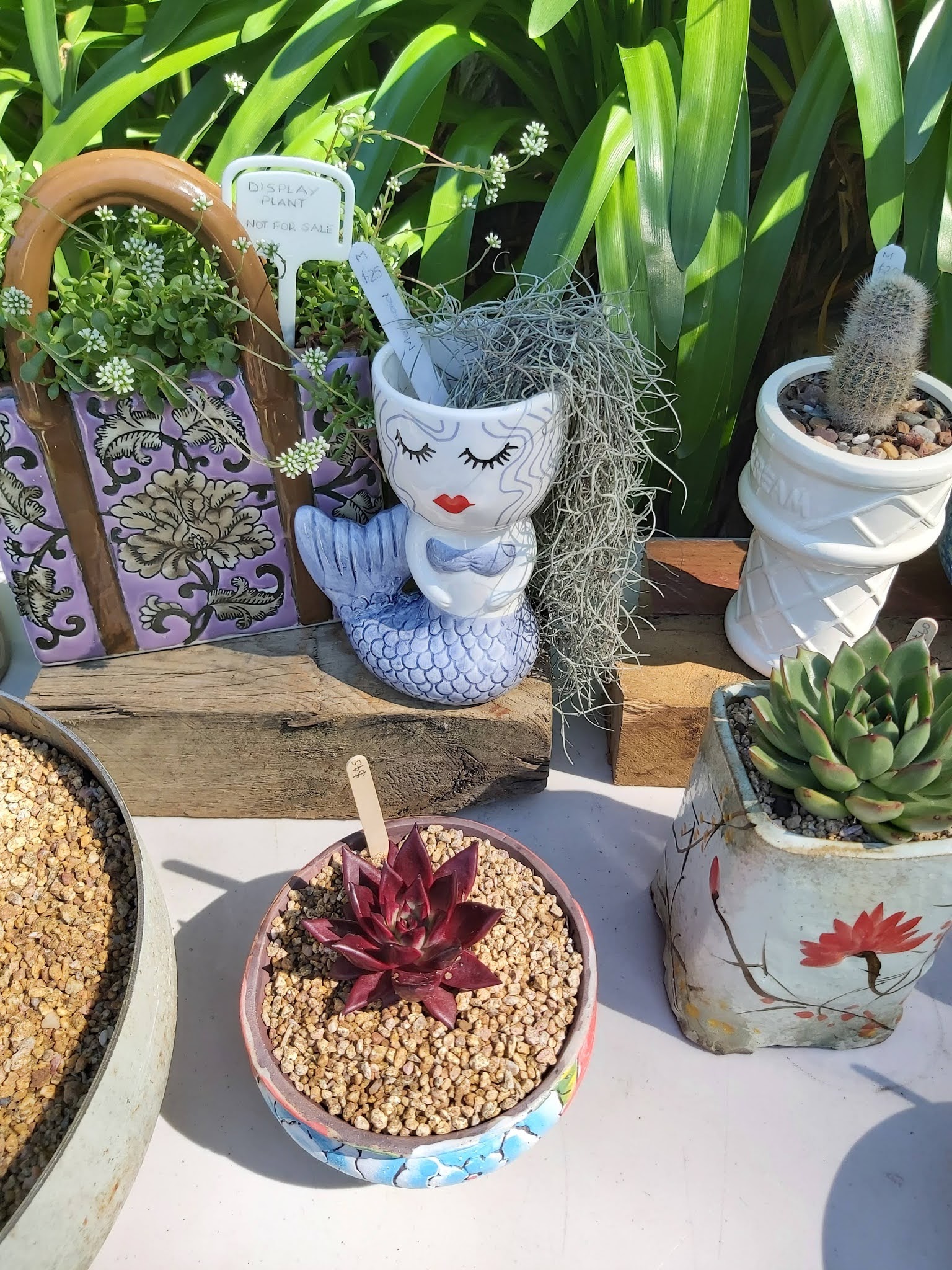
Her love of cute pots is evident with many of her succulents displayed in some unusual pots.  I believe she also runs workshops in how to care and look after succulents, so she must have a lot of expertise and knowledge in how to grow beautiful succulents.  

I love the little mermaid pot (left) with her Tillandsia hair trailing out the top!

I have plenty of Tillandsia (also known as air plants) in my garden.  I need to look around for some interesting pots to display it in, preferably a head so it looks like hair!
We did not get to meet Mary as Tracey said she was not feeling well and was resting at home.  I think she had been able to help Tracey yesterday with setting up the plant display and bringing some of her own plants for the sale.

Another cute head planter (right) with a jelly bean succulent growing in it. 
I loved this little section of her garden, to the side of the driveway.  In front of the raised stonewall garden, there was a wheelbarrow full of Aloe vera plants coming into flower and ready for potting.

Tracey also had trays of cuttings of various succulents priced at just $1.00 each and I picked up one of these for potting up when I got home.
Here on the right are the plants I bought at the sale.  I love the blue pot in front with the flowers painted on it, but not sure of the succulent growing in it.  It is an Echeveria, but do not know the variety.  There is a little flower forming on it.

At the back is a Peperomia dolabriformis (Prayer Pepper) with leaves appearing like little fat pea pods.

On the left is String of Pearls, a succulent I have always wanted (Senicio rowleyanus). It likes to sprawl over the edge of containers or hanging baskets. I also bought a couple of other small pots with unknown succulents in them to add to my collection.

We enjoyed our time spent looking at the plants on display, but I would have liked to have seen a little bit more of Tracey's interesting garden which is spread out on over half an acre.  I know, from her instagram posts, that her husband has built some lovely pathways and steps and retaining stonewall gardens.  However, it was not an open garden display and I am sure that now we have met, there will be other opportunities when we can visit each others' gardens!