Labels

Saturday, 29 January 2022

Cranebrook

 The Lakes Walk, Waterside Estate

On Sunday 16 January, Ken and I drove to Cranebrook and parked our car in Laycock Avenue to explore part of the Lakes Walk.  It turned out to be a much longer walk than we anticipated and we also managed to get lost!  The weather was very hot, over 30 degrees Celsius and foolishly we left our bottle of water in the car, so we were dehydrated and exhausted by the time we made it back.

The Lakes Walk is a leafy and shady track that meanders by the shores of five Lakes and waterways in the Waterside Estate at Cranebrook.   Waterside Estate is a new Lakeside neighbourhood in the heart of the Penrith Valley and not far from the International Regatta Centre, all very close to where we live.  After the heavy rain lately, excess run-off water has flowed into the Lakes.  This water is rich in nutrients which act as food for algae and parts of the Lakes are covered in Blue green algae.   Even though algae is an aquatic plant that occurs naturally in all aquatic habitats, this appeared to be out of control and parts of the Lakes looked as though grass was growing on the water.  

The first part of the walk was very pleasant, but then the track led us out on to a suburban road, which confused us.  The houses facing the Lake in this road are modern two-storey terrace style houses with nice gardens and lots of shady trees.  It did not look like a typical Australian suburban street, but the houses are probably architecturally designed with energy efficient solutions for living in the hot climate of Western Sydney.  It looked a nice place to live.  We turned right along the footpath, continuing over a road bridge to the other side of the first Lake and kept walking down the footpath.  We lost sight of the Lake, but hoped we would eventually come to a track we could follow to take us back there.  

The footpath suddenly came to an end with a barrier across it and beyond the barrier there was a grassy slope down to a road below.  I thought at this stage it might be best to try and retrace our steps, but Ken was keen to keep going forward and get down to the road.  We walked down the steep slope, which took us out on to a hot country road in a rural Cumberland Plain woodland where Grey Box Eucalypts and Forest Red Gums dotted the landscape.  We had obviously left the Waterside Estate and were lost!   

We were now both feeling very hot and dehydrated.  We wanted to sit down and looked around vainly for somewhere to rest!  Ken was very red in the face and I guess I must have looked the same to him.

We saw a young woman coming towards us as she walked her dog along the road, so we went and spoke to her.  

She was friendly and helpful in providing directions that would get us back on track to the Lakes Walk.  However, she said her car was parked nearby and she offered to drive us back to our car.  I was certainly tempted by her kind offer, but we declined as her dog was not very happy at having his walk interrupted.  He was whining and refusing to turn around and walk back to the car.  I took pity on the poor animal, as he was missing a hind leg and the walk was probably the highlight of his day!   We assured the woman we would be OK once we were back on the shady lakes walk.

We thanked her and said good-bye, then walked down the road until we came to the track she had pointed out to us.  It was good to get out of the sun and back into the shady tree lined Lakes Walk.   This final walk took us longer than expected and I was wishing we had accepted the woman's kind offer of a lift, but eventually we  made it to the point where we had entered thus completing our circumnavigation of that first Lake.  

This bridge was the first one we crossed, after we entered the Lakes area from Laycock Avenue.
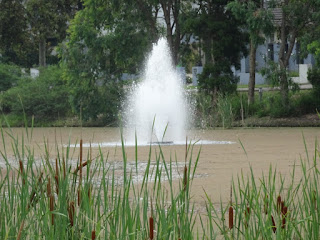
There were several water spouts in the Lakes, which look very pretty and assist  in keeping the water moving.  They also provide algae control.
Here is a crop of blue green algae growing on the surface of the water.  Exposure to blue green algae can cause skin and eye irrations in people who are sensitive.  However, I'm sure nobody would want to swim in the Lakes during an algae infestation.
This young Purple Swamphen (Porphyrio porphyrio) was very friendly and came right up to us.  Obviously, some of the birds are used to getting scraps of food from people passing by.  However, there were signs up requesting people not to feed the wildlife.
The Lakes are a very peaceful spot and a cool retreat on such a hot day.

By the time we finally made it back to our car, we were dry in the mouth and gasping for a cold drink of water.  We had left a bottle of water in a cooler bag in the car, so thankfully, we had a nice cool drink to quench our thirst and revive us! 

We decided next time to make sure we were better equipped for walking and carry backpacks containing essential items such as water, snacks, cameras and first aid kit.  We had not expected the walk to take so long.

We shall be back as there are more Lakes and parks to explore in this area.


Acknowledgments

1.  NSW Government Blue Green Algae Fact Sheet.

2.  Waterside Your New Home by the Water.  Stockland.


Tuesday, 18 January 2022

Cranebrook

 Grey Gums Oval, Cranebrook

On Sunday 9 January we set out to explore a little bit more of our new neighbourhood.  We drove to Grey Gums Oval in Cranebrook, not far from our home and parked the car at the entrance to the Oval on Grey Gums Road.  We then walked past the grandstand, down the hill to an area set aside for the newly created wildflower meadow.  

Penrith local City Council was granted funds under the NSW Government's Greening the Great West Walk Programme and they have used these funds to create a temporary wildflower meadow called "Let it Bee".  The project has been designed to improve the inferior clay soil so that 78 new trees can ultimately be planted.  These trees will boost canopy cover and help in reducing temperatures along the Walk by creating some welcome shade. They will also provide shelter for local wildlife and help enhance biodiversity.  The Great West Walk is a 65 km walk from Parramatta to the base of the Blue Mountains.  

Here is the path inside the gate.  As the gate was locked we left the car on the grass beside the entrance to the Oval.  Maybe the gate is kept locked on days when there are no sporting events taking place, but it was a shame we couldn't drive in and park in the car park.
There were beautiful flowers growing in the wildflower meadow including Bulbine bulbosa, Calotis lappulacea, Pultenaea villosa and Wahlenbergia. These flower species have adapted to Penrith's soils, temperatures and climate over millions of years.   
One of the many bee "hotels" set up in the wildflower gardens.  We saw many butterflies and birds flying amongst the flowers whilst we were there.  These bee hotels provide fun for the children and are also an educational experience.
The flowers will be cultivated back into the soil next May 
This is the area set aside for the wildflower meadow.  In the middle there is the framework of a bee and flower seeds have been planted in it.  There were park benches placed along the pathways where you can sit and enjoy the gardens. 
Seeds from the flowers will be collected for propagation in Council's nursery.
There were many Ibis birds gathered on the Oval.  After the recent rain, the Oval was quite wet with lots of pools of water and this obviously was an attraction for these waterbirds.  From a distance it looked as though the Oval was covered with a flock of sheep!


We enjoyed our time spent in the wildflower meadow.  I was pleased that our local Council is environmentally conscious and involved in a programme to improve our local area and, at the same time, educate the population about climate change and what can be done about it.  Over the coming Summer weeks, we hope to explore a little bit more of our new neighbourhood.  I am especially keen to explore a little bit more of the Penrith Lakes area.

Acknowledgements

1.  Inside Local Government.

2.  Penrith City Council

3.  Australasian Leisure Management

4.  The Western Weekender.

Monday, 20 September 2021

Glenmore Park

 Glenmore Loch

The best part about moving into a new area is exploring your new surroundings.  Now is the perfect time to do this as we are in Covid Lockdown and not permitted to leave our local Government area.  Everyone has been encouraged to participate in exercise walks in their local area so Ken and I are making the most of this opportunity to explore our new environment.

Last Thursday we drove to Glenmore Park and discovered Glenmore Loch.  The Loch is set in a park with a walking track all the way around it.  It is a beautiful tranquil area and a haven for the local birdlife.  There are two bridges over the Loch and outdoor gym fitness equipment dotted alongside the pathway at regular intervals.

We parked our car outside the local Community Centre on the shores of the Loch and walked down to the path and a viewing platform on the shoreline over the Loch.  In the centre of the Loch there is an island with many water birds in residence both on the ground and in the trees. 

Here is Ken standing on the viewing platform stretching out over the Loch.  In the background is the Community Centre and the walking track.  
The first bridge we came to on our walk spans a culvert for water overflow from the Loch.  I love that it is called a Loch and not a Lake.  Scottish Lochs seem to put the word Loch first, eg Loch Ness, Loch Lomond but Glenmore Loch is distinctly Australian with the word Loch appearing last! 
Big, sturdy outdoor gym fitness equipment is placed alongside the path at regular intervals.  Use of this equipment is prohibited during lockdown.
Here is the Loch.  The day was overcast and cloudy, as you can see by the many clouds reflected in the water.  It would look better on a brighter day.  Towards the end of our walk the sun did come out, so I should have gone back and taken more photos!  Next time!!
Here is the second bridge, a little bit longer than the first bridge.  I like the stone pillars and the wrought iron panels.  This bridge is at the end of the Loch and once again spans a culvert.
An Ibis flapping his wings by the edge of the Loch.  There were lots of waterbirds, including Purple swamphens, White-faced Herons, Dusky Moorhens as well as many ducks.

There were fish in the Loch and fishing was permitted, subject to size limits.  I noticed a sign  stating there were Australian Bass, Estuary Perch, Southern Shortfin Eel and Spiny Crayfish in the Loch. We certainly saw evidence of fish as we watched them swimming from the viewing platform.

We completed our circumnavigation of the Loch and returned to our car in the car park.  

As we drove out of the area we admired the many lovely homes surrounding the Loch.  The area of Glenmore Park was mainly rural prior to the 1970's when the first residential subdivision occurred.  In 1990 Glenmore Park was officially opened by the NSW Premier.  Its development has been carefully planned to cater for the social, economic and residential needs of its residents. It appears to be a pleasant place to live. 

Prior to European settlement, the area was home to the Mulgoa people who spoke the Darug language.  The area marked the boundary between two important clans, the Darugs from the plains and the Gundungurra from the Mountains who spoke a different language.   In early Colonial days there were many bloody encounters between the Europeans and Aboriginals, However, these clashes were mainly between the Gundungurras and the Europeans.  The Mulgoa people remained peaceful.

We shall come back to this beautiful area in future weeks as there is much more to explore.

Acknowledgements

1.  Penrith City local history.

2.  Wikipedia.


Tuesday, 14 September 2021

Penrith

 Yandhai Nepean Crossing

Yesterday, during the Covid Lockdown, we drove down to the Nepean River to do our exercise walk  across the Yandhai Nepean Crossing.  We did this walk nearly three years ago, when the bridge was first opened, so we were keen to walk it once again.

We  parked the car conveniently in Memorial Avenue and made our way towards the bridge.  We were shocked to see how much construction work is going on.  A new building was under construction, right alongside the start of the Yandhai bridge.  It is the new Log Cabin Hotel being erected on the site of the old Log Cabin that was gutted by fire nine years ago.  It should be very nice when it is finished, but at the moment it is a construction site and the area is not as peaceful as it used to be!

The Yandhai Nepean Crossing is the longest single clear-span footbridge in Australia.  The main span over the river is 200m long.  It was designed as a triangular Steel Warren truss with curved steel-concrete box approach-spans with viewing platforms and balconies along the structure.  The lighting has also been designed to complement the aesthetics of the bridge.
Here you can see the construction of the new Log Cabin Hotel is well under way.  It is a two storey, 16 million dollar development with indoor and outdoor bars and dining areas, as well as a beer garden and children's play area.  There will be fine dining and function rooms upstairs with outstanding views  overlooking the Nepean River.

The Victoria Bridge spans the River alongside the new Yandhai bridge.   It is a heritage listed former railway bridge and now a wrought iron box plate girder road bridge across the Nepean River on the Great Western Highway.   The bridge was designed by John Whitton and built from 1862 to 1867  It also carries the trains up and over the Blue Mountains.
Emu Hall is a historic house on the western riverbank in Emu Plains.  The house is Victorian Italianate and was built in 1854 for James Tobias Ryan.  Emu Hall is now a cafe with adjoining restaurant and beer garden.  This historic homestead has been renovated, but still retains some remarkable features, including the large windows and French doors that open onto a beautiful garden.
I love this grand gateway entrance to Emu Hall with its stone pillars and wrought iron gates.  In the foreground on the left you can just see part of the trunk of a tree, gaily festooned with fairy lights that would look pretty when lit-up at night.
Inside the gates, the garden has remnant plantings remaining, including clusters of Jacarandas, Camphor Laurels and Bunya Pine trees.
This photo shows the lovely curved steel approach span in the bridge from the Emu Plains side. One of the viewing platforms is incorporated in the curve. 
An Explorers Memorial to commemorate the crossing of the Blue Mountains by Blaxland, Lawson and Wentworth in 1813 stands outside the entrance to the bridge in a little park on the Penrith side. 

It is a clock memorial (showing the correct time) standing in a rose garden.  The Memorial also commemorates the further expeditions and surveys by George Evans and William Cox.

It was starting to rain as we left the Memorial, so we hurried back to our car, glad we didn't have to walk very far.  

We continued to drive down Memorial Avenue, and into Nepean Avenue admiring the many lovely homes in this street on the Eastern bank of the Nepean River.  The road comes to a dead end when it meets Tench Reserve and the point at which we concluded our recent walk in Tench ReserveNepean Avenue forms part of the loop section of the Great River Walk as it leads directly to the Yandhai Nepean Crossing.

The word Yandhai comes from the Darug language and means "walking in the path of past and present"  and is reflective of story telling, including the past use of the river by the Darug people. The Darugs have strong traditional and historical ties to Western Sydney and the Nepean River, so the name Yandhai Nepean Crossing is a fitting name for this pedestrian bridge.

Acknowledgements

1.  Seymour Whyte
2.  Visit Penrith.
3.  Weekender - Alena Higgins Senior News Reporter.
4.  Blue Mountains Gazette 24.10.2018
5.  Wikipedia.
6.  Emu Hall Bar & Kitchen.


Saturday, 4 September 2021

Penrith

Mulberry Lane, Tench Reserve, Penrith

On Thursday afternoon, we did our Covid Lockdown exercise walk in our Local Government Area along the Memory Walk in Tench Reserve beside the Nepean River (in Darug country).  We parked the car in the car park along Tench Avenue and walked along the footpath until we came to the beginning of Memory Walk.  This is a wide concrete path leading to Nepean Avenue.  There were many people taking advantage of the pleasant weather and doing an exercise walk up to Nepean Avenue and back.  We too were exercising, in a more leisurely fashion and taking photographs along the way.  

Here is the beginning of Memory Walk and halfway down the path on the left-hand side are some Californian Redwood trees.  There is a plaque stating that the trees were "planted in honour of the men and women who served Australia in time of conflict during World War 11.  Lest we forget."
Here is a picture showing the Californian Redwood trees on the right of the path.  The Californian Redwoods are amongst the oldest living things on earth with a lifespan of 1,200 - 1,800 years.  They are also the tallest species of tree growing on the planet growing up to 115 metres in the forests of Northern California.
Here are the Mulberry trees in Mulberry Lane.  The trees are laden with fruit, just beginning to ripen.  The public is welcome to pick the fruit and many people come and pick this luscious crop, generously provided by the local Council. They request that people do not be greedy and leave fruit for others and not to damage the trees by climbing them. 
This picture shows the nobbly and gnarled trunks of the Mulberry trees.  The Mulberry is a deciduous self-fertile tree from 5-20 metres.  They have glossy heart-shaped green leaves and pendulous branches and make a good shade tree.  After a while the trees develop a lovely gnarled trunk.  
The mulberries are red at the moment but starting to turn black. By November they should be ready for harvest.  We shall be coming back in November as I believe the Red-whiskered Bulbul likes to visit and eat the mulberries.  I am keen to photograph him and add him to my collection of birds seen in the Penrith area.
 In the orchard, past Mulberry Lane, the blossom trees are  starting to flower and looking very pretty.  Some trees have white blossoms and others have pink.
Now and then through the trees we could catch a glimpse of the river as it shimmered and sparkled in the afternoon sunlight.

We did not venture out into Nepean Avenue but decided to head back to the car.

We will come back another day and continue the walk along Nepean Avenue as it eventually leads to the Yandhai Nepean Crossing across the river and is part of the Great River Walk. It would be nice to walk across this pedestrian bridge again as we have not done this since it opened in 2018.  It was a perfect afternoon for our walk, which we enjoyed very much.  It is simple things, like walks, that makes lockdown more bearable!  As from yesterday, exercise time has been extended from one hour per day to unlimited time from 5 am to curfew at 9 pm.


Acknowledgments

1.  Our Place - Penrith City Council's quarterly Newsletter Autumn 2021.

2.  Garden Clinic by Linda Ross 9.2.2015

3.  Birdlife Australia (Red-whiskered Bulbul)

Sunday, 27 June 2021

Sydney

St. Andrew's Anglican Cathedral, Sydney

To-day is the first day of the Greater Sydney lockdown, caused by the spread of the Covid 19 virus.  We are confined to our homes for the next two weeks.  As it is a Sunday and we are not permitted to attend Church, we watched the 10.30 am service of Morning Prayer at St. Andrew's Cathedral in Sydney, live streamed on our TV.

There were no parishioners or worshippers in the Cathedral and just a skeleton staff to attend to proceedings.   The Leader was Chris Allan (Acting Dean), organist (Ross Cobb), bible readers, singer, preacher Rev. Garry Dibley from CMS and camera technicians. They all did a great job, but I did miss the choir.  

Because the Choir was absent, all the hymns were sung by a solo singer and he did a magnificent job.  The words to all the hymns were on the TV screen, so it was easy to sing along to these well-known hymns - "God of grace and God of Glory", "I heard the voice of Jesus say" and "Can it be".

This is the outside view of St. Andrew's Cathedral, Sydney.  The Cathedral  faces George Street, next-door to the Town Hall.  It is Gothic Revival architecture designed primarily by Edmund Blacket from 1837-1868.  It is built in Sydney sandstone and is the oldest cathedral in Australia.
This beautiful seven-light and four tiered stained glass East window above the communion table is a complex composition depicting scenes in the life of Christ at which the apostle Andrew was present, such as the Feeding of the Five Thousand.
The organist up high in the organ loft.  The organ is an amalgamation of two organs, one by William Hill & Sons (1866) and another by John Whitely (1929) and restored by the Canadian firm Orgues Letoumeau.  During non-lockdown times there are regular lunchtime organ recitals.
Rev. Christopher Allan, the Acting Dean of Sydney.  He said the Cathedral will be closed to the public during the current lockdown and all services will be on-line only, for the time being.
Rev. Garry Dibley delivered the sermon.  He preached on Acts 9: 1-20 the dramatic conversion story of Saul on the road to Damascus.  

Saul was travelling on the road, looking for followers of Jesus to take as prisoners, when a light from heaven flashed around him and he heard the voice of Jesus speak to him, asking, "Why do you persecute me?"  He was then struck blind and had to be led into Damascus by the men travelling with him.  

After three days a man named Ananias placed his hands on Saul and said that Jesus had sent him to heal him and immediately scales fell from Saul's eyes and he could see again. He was then filled with the Holy Spirit and baptised.

Rev. Garry said it was never too late to be saved by Jesus.  God has the power to use even the hostile persecutor to achieve his divine purpose.

We enjoyed being able to watch the service in the comfort of our own home and felt grateful that modern technology enables us to watch and partake in Church services by joining in with the responses and the singing of hymns.

Acknowledgments

1.  Wikipedia
2.  St. Andrew's Cathedral website.


Thursday, 24 June 2021

Emu Plains

The Lewers Cafe and Art Gallery

We have had family from interstate visiting us and, on Tuesday, we all had lunch at the Lewers Cafe at 86 River Road, Emu Plains.  This cafe is now part of the Penrith Regional Art Gallery which is set in the former home of Australian Artists Gerald and Margo Lewers.  These leading artists were part of the development of modernism in Australian art.  After Gerald and Margo died, their home was gifted by the Lewers family to the people of Penrith as the Lewers Bequest, with the vision to create a centre of excellence for the presentation and appreciation of art for the community.  The Gallery regularly presents exhibitions, workshops and special events, both inside and outside in the beautiful gardens surrounding the home.  The gardens are maintained by heritage gardeners with seasonal vegetables grown and used in meals served in the cafe.  The Gallery is in a picturesque location along the Great River Walk facing the Nepean River on the Emu Plains side.

We had lunch first, before exploring the Galleries and garden.  We started with drinks and I had a Miss Ginny cocktail, followed by a lunch of Roast lamb with crispy polenta and vegetables which was delicious.

There are three galleries to explore.  One is in the original homestead of the artists and this is called Lewers House.  The second one is Ancher House built as a granny flat for Margo Lewers' mother and the other is a purpose built gallery, with a gallery shop, at the end of the cafe.

This picture was taken looking through the windows at the back of the Gallery at the end of the cafe and looking into the heritage garden.  The garden has many exotic species of plants and succulents.  The original house was built in 1905 and was bought by the Lewers in 1942.  Several of Gerald's sculptures are placed in the garden.
These paintings are hanging on the walls in Ancher House. This house was  designed by architect Sydney Ancher for Margo Lewers' mother, who died as the house was being completed.  Margo won recognition as a leading postwar Abstract expressionist.


This beautiful stained glass window is a fanlight above the front door of the house and a similar window is also above the door at the end of the hallway.  The sidelight windows beside the doors had similar designs and were also stained glass windows.
A French Window inside the house.  This window is actually a door and is opened by sliding it upwards.  You can then step outside on to the verandah and out into the garden. 
This artwork is in the present exhibition being shown in the Gallery.  It is by Ada Bird Petyarre, an indigenous artist who lived in a community 230km North East of Alice SpringsAda worked in both painting and batik.  Her work has been exhibited nationally and internationally and collected by major galleries around the world.  She was part of an early indigenous art movement.

There was also artwork by another exhibitor, Dr David MiddlebrookDavid is a landscape artist who works in pen and ink, sepia and large oil paintings.  His work revolves around the horizon  which he views as a drive to strive for the unobtainable.  He likes to explore the impact of the horizon in different media.

For the last three years of Ada's life, Ada and David Middlebrook were friends and their friendship changed David's concept of landscape.  Ada liked to look at David's drawings  and if she recognised the landscape she would sing it.  For David, this brought his drawings to life.  David collaborated with Ada while he was undertaking research for his PhD degree and his thesis was on exploring the horizon.

The current exhibition is called Bird Petyarre & Middlebrook and opened on 15 May and will conclude on 22 August.  It is well worth a visit.

After our walk around the Galleries we stepped out into the garden, admiring the many different species of plants.  We enjoyed our visit to the Penrith Regional Gallery and the historic Lewers home, very much.  

Acknowledgments

1.  Art Atrium website
2.  Penrith Regional Gallery website
3.  Wikipedia.
4.  "Looking at or being landscape" by Dr. David Middlebrook